Co-creation Models For Inclusive Film Productions (Online)
Price £55 | 375
-
-
*Edit* This course will now be held online, to make it more accessible. The dates have changed. Please see below for the correct dates.
If you have questions, please consult our new FAQs page before contacting us.
We have also updated policies for course costs/concessions and bursaries. Please see our Terms and conditions.
If you would like to:
Find out more information about UCL Public Anthropology Short Courses
- Be updated with info such as future course dates and prices
- Be the first to know when new courses go online
Co-Creation Models For Inclusive Film Productions
- WHAT: This brand new online course offers you sessions delivered directly from artist-filmmaker Steven Eastwood, filmmaker Chloe White and the Stims Collective team. It is aimed at film professionals or those already within the industry, to gain skills and knowledge for the creation and delivery of co-creation and collaborative projects, and insight into how to create, programme and finance inclusive film projects.
WHERE: Online, please join from the comfort of your own home.
WHO: Run by Steven Eastwood (Autism through cinema), Chloe White (Whalebone Films) and Stims Collective: Georgia Bradburn, Sam Chown-Ahern, and Lillian Crawford.
WHEN: March 16th – 20th April 2026
COMMITMENT: Varying number of hours per week (Please see schedule below for breakdown)
WHAT YOU GET: 7 online sessions with film professionals from across production and exhibition, to gain a thorough grounding in non-fiction film activism and advocacy, the mechanisms of inclusive working environments, and case studies of film aesthetics and structures.
HOW MUCH: Individual Session: £55 | Full Course: £375
DEADLINE TO SIGN UP: Rolling basis, please sign up as soon as possible to avoid disappointment.
AGES: 18+
BURSARIES: We have now closed bursary applications for this course.
-
-
- From the team that created The Stimming Pool (2024), the course will provide a thorough grounding in the essential tools, practices and strategies for developing and exhibiting collaborative and inclusive productions. Sessions will include collaborative activities and discussions to inform future producers, production managers, exhibitors and film professionals on how to contribute to an industry that supports inclusive methodologies and practical applications of inclusivity, particularly for neurodivergent and disabled communities. The course will involve break-out activities where participants are encouraged to explore and troubleshoot potential co-creation projects of their own.
Intended Learning Outcomes:
- Develop potential co-creation projects, meet potential collaborators
- Learn how to embrace the IP complexity that inevitably and necessarily arises from co-creation projects, and how the rights of artists and contributors can be better defined and enshrined in contracts, ownership models, roles and sign-off mechanisms
- Workshop on how potential subjects might become collaborators/co-authors.
- Explore a number of films that have used distinct concepts, aesthetics and structures to more accurately represent subjects
- Explore how inclusive and co-created film productions can partner with arts organisations and exhibitors to run relaxed screenings, and will also consider how funders could be more accessible.
- Study non-fiction film activism and advocacy in the context of disability, through case study films
The course will take place (online) on the following dates:
Session 1: [online] DOCUMENTARY AND DISABILITY – Monday 16th March (7 PM – 9 PM)
Session 2: [online] PARTICIPATORY / CO-CREATION METHODS – Monday 23rd March (7 PM – 9 PM)
Session 3: [online] FUNDING PROJECTS THAT USE PROGRESSIVE PRODUCTION MODELS – Thurs 26th March (7 PM – 9 PM)
-Mid-Course Break for Easter-
Session 4: [online] MAKING ACCESSIBLE AND INCLUSIVE PRODUCTIONS – Monday 13th April (7 PM – 9 PM)
Session 5: [online] MAKING IMPACTFUL FILMS – Saturday the 18th of April (10:30 AM – 12:30 PM)
Session 6: [online] THE FORM OF RADICAL NONFICTION / THE AUTISTIC CAMERA – Saturday the 18th of April (1:30 PM – 3:30 PM)
Session 7: [online] FIXING FILM ENVIRONMENTS – Monday the 20th of April (7 PM – 9 PM)
Indicative course outline:
Session 1:
Monday 16th March (7 PM – 9 PM)
DOCUMENTARY AND DISABILITY
With Steven Eastwood
This introductory session explores changes in nonfiction film practices in the context of the disability rights movement, surveying disability documentary film activism and advocacy through case study films such as Crip Camp, Yes, We Fuck!, Patrice the Movie, Is There Anybody Out There?, Unrest, Gallivant, and others, looking at disability film festivals such as Oska Bright, and the work of FWD-Doc.
Sessions 2:
Monday 23rd March (7 PM – 9 PM)
PARTICIPATORY / CO-CREATION METHODS
With Steven Eastwood
Using The Stimming Pool (2024) as a case study film, the session will provide an overview of how film production can adopt shared authorship structures, examining both the challenges and insights of such an approach. The session will reference the innovative work of the Project Art Works collective and draw upon the ground-breaking MIT publication Collective Wisdom. We will look at other films that work from a participatory method, including Holloway (2024) and The Work (2017). There will be a break-out activity where participants are encouraged to explore and troubleshoot potential co-creation projects of their own.
Session 3:
Thurs 26th March (7 PM – 9 PM)
FUNDING PROJECTS THAT USE PROGRESSIVE PRODUCTION MODELS
With Steven Eastwood & Chloe White
In this session, we will go over in detail how innovative and inclusive projects often involve bringing together very different funding, for example, from research councils, arts funders, equity finance, through crowd sourcing, or via in-kind support. How can the expectations of each of these sources be aligned? The seminar will look at forming SPVs (special purpose vehicles), embracing the IP complexity that inevitably and necessarily arises from co-creation projects, and how the rights of artists and contributors can be better defined and enshrined in contracts, ownership models, roles and sign-off mechanisms. In small groups you will discuss potential funding and ownership structures.
-Mid-course Easter Break-
Session 4
Monday 13th April (7 PM – 9 PM)
MAKING ACCESSIBLE AND INCLUSIVE PRODUCTIONS
With Steven Eastwood, Chloe White & Sam Chown-Ahern
Using The Stimming Pool (2024) as a case study film, this week will describe the things that can be put in place to ensure that a production has considered and provided support for the many different needs and requirements of collaborators, contributors and crew. This will involve the role of specialist advisors, disability riders, decision-making processes, how to draft accessible call sheets, veto rights, consent mechanisms and more, and how shared authorship requires inclusion across all aspects of production, post-production and exhibition. There will be a break-out activity where you workshop how your potential subjects might become collaborators/co-authors.
Session 5:
Saturday the 18th of April (10:30 AM – 12:30 PM)
MAKING IMPACTFUL FILMS
With Steven Eastwood
The concluding session in the series explores how to make sure that documentaries are impactful following primary release via festivals, cinemas and streaming platforms. This will involve exploring social media strategies, running influencer events, hosting activities with community and charitable partners to fully understand and harness the impact potential of a film. We will also discuss how parallel initiatives, such as expanded/gallery exhibitions, toolkits, and publications, can diversify and maximise impact. This will include case study projects such as STIM CINEMA (the parallel artwork to The Stimming Pool) and The Interval and the Instant (the parallel artwork to Eastwood’s documentary ISLAND)
Session 6
Saturday the 18th of April (1:30 PM – 3:30 PM)
THE FORM OF RADICAL NONFICTION / THE AUTISTIC CAMERA
With Georgia Bradburn & Steven Eastwood
How can the form a film adopts be more reflective of its content? The session will explore a number of films that have used distinct concepts, aesthetics and structures to more accurately represent subjects, communities and worlds, for example in the work of the Harvard Sensory Ethnography Lab, and in ground-breaking fact-fiction hybrids such as The Arbor (Barnard), and Dahomey (Diop). The session will then focus on the concept of the ‘autistic camera’ and how it was used in the making of The Stimming Pool.
Session 7:
Monday, the 20th of April (7 PM – 9 PM)
FIXING FILM ENVIRONMENTS
Led by STIMS COLLECTIVE: Georgia Bradburn, Sam Chown-Ahern, Lillian Crawford
The sessions will explore how inclusive and co-created film productions can partner with arts organisations and exhibitors to run relaxed screenings, and will also consider how funders could be more accessible.
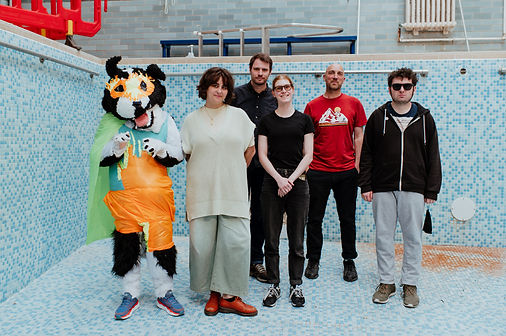
NC team on set for The Stimming Pool.
This course offers bursary places. Please check our Terms and Conditions to see if you are eligible to apply.
If you still have other questions relating to a specific course or request, please get in touch with us via email shortcourses@opencitylondon.com
Image Credit: Still from The Stimming Pool 2024
What is UCL’s section of Public Anthropology?
Public Anthropology is a subsection of UCL’s Anthropology department. It hosts the short course programme, Open City Documentary Festival, and several graduate degree programmes.
The two main strands within Public Anthropology are media and creative and collaborative enterprise, which both merge industry expertise with academic research agendas.
Graduate degree programmes based in the Public Anthropology section include:
Public Anthropology houses London’s global non-fiction film festival, Open City Documentary Festival. Open City Documentary Festival produces an annual film festival, the bi-annual journal Non-Fiction and screening projects throughout the year.
Public Anthropology runs short courses in filmmaking, audio, virtual reality, film theory, practical camera training and film editing.
Tutors

Steven Eastwood
Course Leader
Steven Eastwood's research as an artist-filmmaker and professor of Film Practice focuses on ethics and the complexity of encounter between filmmaker and subject. His second feature film, Island (2018), had its international premiere at Rotterdam Film Festival in 2018 and was released in UK cinemas. His first feature film Buried Land (2010) premiered at Tribeca film festival. Recent solo and group exhibitions include Fabrica Brighton, La Ferme du Buisson Paris, and Blackwood Toronto. His documentary Those Who Are Jesus (2001) was nominated for a Grierson Award
Sam Chown-Ahern
Course Tutor
Sam Chown-Ahern is a visual artist who works with drawing, illustration, bookworks, photography and sound. Sam is a graduate of Wimbledon School of Art. Recent group shows include Barbican Young Visual Arts 2020. Sam has been an active member of the Autism Youth Council and co-presented the Channel 4 documentary 'Are You Autistic?' Sam also featured as a special guest on an episode of the Autism Through Cinema podcast where she discussed Steven Spielberg's 1982 sci-fi classic ET: The Extra Terrestrial.
Georgia Bradburn
Course Tutor
Georgia Bradburn is a film studies graduate of Queen Mary University of London. Her blog 'The Autistic Film Critic' seeks to expand traditional readings of film to incorporate a neurodiverse perspective. Her film practice explores how her experience of autism can be transferred to a visual medium. An early fascination with the films of David Lynch have encouraged her interest in experimental film, surrealism and horror, leading to the development of several short films which can be found on her blog. She is currently working on a semi-autobiographical installation film drawing on themes of metamorphosis, suburbia and adolescence. She is also a regular co-host on the Autism Through Cinema podcast.
Lillian Crawford
Course Tutor
Lillian Crawford is a freelance writer covering film and culture for publications including Sight & Sound, BBC Culture and The Guardian. Lillian is a prolific programmer and curator, including for the BFI, the Barbican, the Garden Cinema, the Edinburgh International Film Festival, and the EUNIC In Short Film Festival. Her work with the Autism Through Cinema project and podcast led to the foundation of the Stims Collective which curates relaxed screenings for neurodiverse audiences. Lillian also writes and edits video essays, and her podcast and blog on British film and television, Listen to Lillian.
Chloe White
Course Tutor
Chloe White is an award-winning documentary filmmaker and photographer and director of Whalebone Films.
Her films are intimate, considered portraits, focusing mainly on the female experience.
Her clients and partners include the Guardian, Topic, Al Jazeera, Nowness, BBC, Channel 4, Oxfam, Save the Children and the BFI. She has had her films screen at festivals internationally including at IDFA, CPH, Camden International Film Festival, Open City, and Sheffield Doc Fest and is a winner of the prestigious Macdowell fellowship.
Chloe lectures in Documentary Film at the University College London and London College of Communications, and lives in Hastings, UK.