Homemade: Telling Stories of Home with the Tools You Already Have (online & in-person)
Price £325
-
- If you have questions, please consult our new FAQs page before contacting us.
We have also updated policies for course costs/concessions and bursaries. Please see our Terms and Conditions.
If you would like to:
- Find out more information about UCL Public Anthropology Short Courses
- Be updated with info such as future course dates and prices
- Be the first to know when new courses go online
Please sign up for our newsletter.
- If you have questions, please consult our new FAQs page before contacting us.
HOMEMADE: Telling Stories of Home with the Tools You Already Have
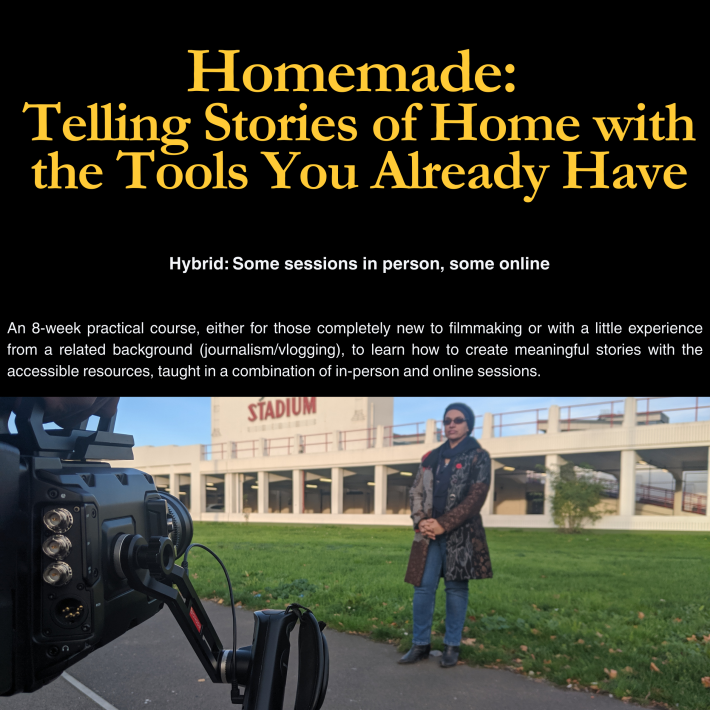
- WHAT: An 8-week practical course, either for those completely new to filmmaking or with a little experience from a related background (journalism/vlogging), to learn how to create meaningful stories with the accessible resources, taught in a combination of in-person and online sessions.
WHERE: Some sessions will be in-person at UCL East, and others will be online.
ADDRESS: UCL East, Marshgate Building, 7 Sidings St, London E20 2AE.
COURSE LEADER: Run by UCL mentor and professional filmmaker, Ashton John.
WHEN: Eight weeks, Wednesday evenings, 6-8 PM, 23rd September –11th November 2026
COMMITMENT: 2 hours contact time per week, with 4-6 hours flexible learning.
WHAT YOU GET: Contact time with a professional filmmaker and educator, a safe environment to explore ideas, and connections with a small group of aspiring filmmakers.
HOW MUCH: £325 | Concessions: £275.00 | UCL Students: £255.00
BURSARIES: Now Closed.
DEADLINE TO SIGN UP: TBC.
AGES: 18+
Course Overview:
What defines a home, and what resources can we use to explore it?
This 8-week intensive course is open to those from varying backgrounds (completely new or with some experience) to come together and feel a sense of community telling stories about a place, space or group that connects to a sense of home. Using technology and software already available (such as your smartphone or a camera you may already have), you will learn how to create compelling documentary stories that you can continue to work on after the course.
What you will gain
- Insight into how to think of new ideas and capture meaningful stories
- Transferable skills to the technologies freely available (phones, social media, etc)
- A practical grounding in entry-level videography and editing
- An understanding of ways to distribute your films; skills that can be applied across multiple platforms, including social media, vlogging and content creation
- Final screening and feedback with your peers
- Build a community of filmmakers with whom you can work
What you will need
Participants should have access to:
- Either a smartphone, a digital camera or a DSLR camera for filming
- Sufficient free space on their phone or camera to store footage
- A laptop or computer that can handle basic video editing (minimum 8GB RAM recommended). This should have enough storage, at least 30–50GB of free storage space for saving video files and project files.
- Access to free editing software such as DaVinci Resolve (you will be guided through the setup process)
Please contact us if you have any questions about the above or would like UCL to assist you with accessing shooting or editing equipment.
HOME Project
Ashton John is a documentary filmmaker and founder of the Home film project, which explores our connection to home, place, and community through personal stories.

Image from HOME Project, featuring Alice.
IMPORTANT INFORMATION
Due to UCL closure days, this course will take place on various days over its duration (mostly on Wednesdays, with one Tuesday, Thursday & Monday). Please check the specific dates below and make sure you are available for all the dates.
Course Breakdown:
Testimonials:
“It was really eye-opening to see the process of making a film. I liked the variety of skills that we learned and really enjoyed the process.”
-HOMEMADE Student, 2025
“Absolutely brilliant! The quality of the course is of a very high standard. Ashton is very knowlegable”
-HOMEMADE Student, 2025
This course offers bursary places. Please check our Terms and conditions to see if you are eligible to apply.
If you still have questions relating to our short course programme at UCL/Open City, please get in touch with us via emailing shortcourses@opencitylondon.com
If you have questions about the specifics of this course, please contact the course tutor Ashton, at: ashton@ajfilms.co.uk
What is UCL’s section of Public Anthropology?
Public Anthropology is a subsection of UCL’s Anthropology department. It hosts the short course programme, Open City Documentary Festival, and several graduate degree programmes.
The two main strands within Public Anthropology are media and creative and collaborative enterprise, which both merge industry expertise with academic research agendas.
Graduate degree programmes based in the Public Anthropology section include:
Public Anthropology houses London’s global non-fiction film festival, Open City Documentary Festival. Open City Documentary Festival produces an annual film festival, the bi-annual journal Non-Fiction and screening projects throughout the year.
Public Anthropology runs short courses in filmmaking, audio, virtual reality & film theory.
Are you a non-fiction storyteller who can deliver compelling workshops/classes? To express interest in working with us, please complete this form.
Tutors

Ashton John
Course Leader
Ashton John is an award-winning Filmmaker, specialising in documentary and commercial films.
Born in Hackney London, his work focuses on documenting diverse communities, everyday people that pass us by exposing audiences from the streets to the personal intimate portraits behind closed doors.
Ashton’s films are about people for people, to inspire change and social awareness.