Unveiling Elderly Care: Haneda Sumiko’s Cinematic Exploration

Although the inspiration stemmed from an earlier project for Iwanami Productions, The World of Dementia (1986) sparked Haneda’s journey into exploring the challenges of ageing for Japan, which subsequently evolved into a pivotal theme during her career as an independent filmmaker. In the 1980s, Tanabe Pharmaceuticals began producing medications for dementia. For promotional purposes, they commissioned Iwanami Productions to produce a film for healthcare professionals, focusing on the care of Alzheimer’s patients [1]. Leveraging a collaboration spanning over three decades and possessing extensive experience in institutional film production, Iwanami Productions entrusted this project to Haneda, who had already become an independent filmmaker at this time. Haneda conducted on-site filming in collaboration with a specialised dementia care hospital in Kyushu, and completed a 50-minute film in 1983, titled Caring for the Elderly with Dementia (Chihōsei rōjin no kaigo). During the filming process, Haneda acutely recognized the pressing need for broader awareness of this issue, and then, she proposed to Iwanami Productions to make a film geared towards the general public. Following further shooting, in 1986, Haneda completed an 84-minute documentary, titled The World of Dementia (Chihōsei rōjin no sekai).
The film is composed of daily segments of elderly dementia patients in a specialised nursing facility, unveiling the lesser-known world of the elderly with dementia and conveying effective caregiving practices to the public. The hospital’s director, Murofushi, regarded dementia as a “personality disorder”. By asserting that dementia patients maintain emotional perceptibility, he advocated for an emotion-centred care approach to alleviate dementia symptoms [2]. Under this pioneering care philosophy, hospital staff respect and highly prioritize the emotional needs of dementia patients. For instance, in a scene where a confused patient named Tsui insists on returning home to care for her grandchildren, a male caregiver chooses to accompany her for a walk around the hospital to prevent her from feeling restricted.

- A male hospital staff accompanies Tsui, who wants to go home, for a walk outside the hospital.
The nurturing care environment enables older people to manifest emotional bonds established with others. Through a lens imbued with a profound sense of humanism. Haneda portrays the elderly through their relationships and vibrant personalities, infusing the film with heartfelt warmth. The film highlights the positive effects of family companionship on the emotional state of the elderly, while also capturing friendly interactions among female dementia patients with moments of mutual care, pleasant conversations, and warm greetings. In addition, the film’s focus extends beyond portraying the acts of “forgetting” in dementia patients; it also indirectly delves into the intricacies of their personalities by depicting their “remembering”. For instance, a patient named Sadako, who struggles to recall her own name, displays a remarkable ability to recite the poems from the Japanese traditional poetry “Hyakunin Isshu”. Similarly, Yae, 84 years old but believing herself to be 48, showcases great skill in making rice cakes during the hospital’s year-end event. Despite the decline in their cognitive abilities, they maintain a vibrant spirit within their constrained world.
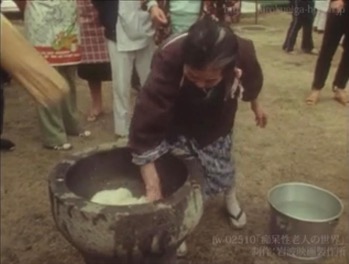
- Yae skillfully makes rice cakes at the hospital’s year-end event.
From a technical perspective, to capture the most natural state of the patients, the crew made specific adjustments to lighting and audio equipment. They installed additional lighting over a frame in the hospital lobby to ensure clear shots of the patients. Furthermore, sound engineer Osamu Takizawa attached a microphone to a pole and synchronised it with the camera to ensure clear audibility of the elderly’s murmurs [3]. Cinematographer Nishio Kiyoshi’s shots are long and slow, aligned with the rhythm of the elderly’s pace, observing them with a serene gaze. The simple and soothing music, composed by Yoshiyuki Totaka, adds poetic resonance to their daily lives. Towards the film’s conclusion, the crew revisited the expanded hospital two years later. With tender and uplifting music, the film ends with a scene of caregivers assisting the elderly with bathing, leaving the audience with further reflections on dementia and aging.
The film garnered an unexpectedly enthusiastic response upon its release and went on an 8-week roadshow screening at Iwanami Hall, totalling over a thousand showings [4]. Notably, the film earned the Best Cultural Film Award at the 1985 Kinema Junpo Awards and the Best Educational Culture Film Award at the Mainichi Film Awards. With the film came more attention to the potential issue brought by aging. This, in turn, motivated Haneda to delve even further into the realm of elderly care concerns, resulting in subsequent films such as Getting Old Without Anxiety (Anshin shite oiru tame ni) (1990) and Town’s Welfare that Residents Selected (Jūmin ga sentaku shita machi no fukushi) (1997). In response to the escalating impact of an aging population, Japan has made significant strides in refining care for older people and welfare policies over the years. The establishment of dementia treatment wards and day-care centres in 1988 marked a pivotal development, followed by the emergence of specialised “group homes” for dementia patients in the late 1990s. As the new century unfolds, Japan’s continuous improvement of its dementia care infrastructure, policies, and welfare initiatives offers a broader horizon for addressing elderly care challenges.
References:
[1]: Haneda, Sumiko. Eiga to Watashi 映画と私 [Films and Me]. Tōkyō: Shobunsha, 2002. Print.
[2], [4]: Haneda, Sumiko. Watashi no Kiroku Eiga Jinsei私の記録映画人生 [My Documentary Film Life]. Tōkyō: Iwanami Shoten, 2014. Print.
[3]: Kaneko Yū. “Interview with Director Haneda Sumiko.” Web neo, 14 June. 2013, http://webneo.org/archives/9515.
This text was commissioned by Open City Documentary Festival to accompany a screening of THE WORLD OF DEMENTIA (1986, dir. Haneda Sumiko) & THE BRIGHTNESS OF THE DAY a.k.a I WANT THE SUN (1995, dir. Satō Makoto) at ICA, 10 September 2023.
This screening was first presented in the retrospective dedicated to Haneda Sumiko’s work at the Jeu de Paume in 2022, curated by Ricardo Matos Cabo & Teresa Castro.
LU SIYU is a Film Studies Ph.D. candidate at Waseda University, Japan, with a background in finance and economics from the University of Nottingham and University College London. Her research centres on Asian female filmmakers and Chinese socialist cinema, with a focus on women’s portrayal in Chinese cinema.