Maeve Brennan on Siticulosa

By Ellie Dobbs
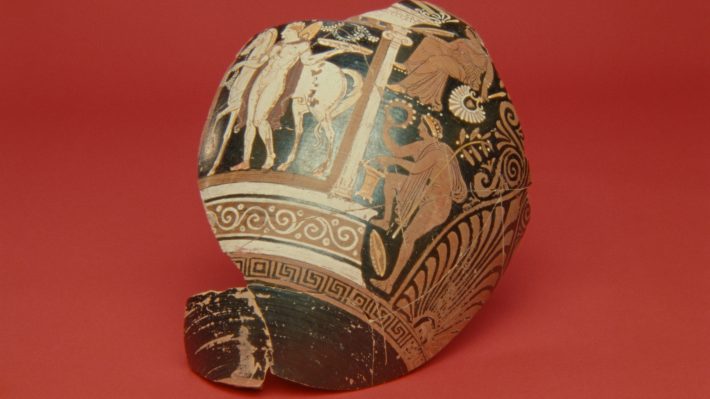
If I were to select just one object at random from the online database of the Illicit Antiquities Network – a project that traces the movement of looted artefacts along global trafficking routes – I would start with an Apulian ‘Gnathia Hydria’ vase from the 4th century BC. The vase is glazed and delicately ribbed, with two elegant, curved handles. Encircling its body is a painted band, adorned with unfurling tendrils and the pale, tilted head of a goddess. While most of the images in the database are difficult to make out, uploaded as low-resolution scans of Polaroids, this one is clear, with the vase’s remarkable detail thrown into relief by a jewel-green backdrop and signature flash of ’80s catalogue photography. The image is sourced from the archives of David Holland Swingler, a food importer turned art trafficker who smuggled antiquities underneath piles of dried pasta. In the photograph of the vase, a typewritten note declares it ‘a gem of ancient workmanship’: covetable and, above all, sellable. On the webpage, a timeline of the object tells us that it has changed hands at least four times since 1980, moving through a small network of dealers and collectors, all orbiting the now-shuttered Royal-Athena Galleries in New York.
The vase’s journey from tomb to display case, and the conditions of its extraction, circulation, and eventual exhibition, are the focus of Maeve Brennan’s Siticulosa (2025), which opened this year’s Open City Documentary Festival, where it was presented alongside her earlier film, An Excavation (2022). Both films take southern Italy’s Apulia as their terrain, focusing on the region’s thriving illicit antiquities trade. Taken from the 2,500-year-old graves of the indigenous Apulian upper classes, richly decorated funerary vessels, vases, and plates surface throughout, but Brennan is more interested in processes of extraction than the vases themselves. Considered together, the two films trace a complex supply chain that begins with the tombaroli (gravediggers) and, via the art world’s own extractors (dealers, collectors, and auction houses), ends in some of London’s largest museums. Supply and demand shape this chain. If there were no desire to trade in these objects, would they be unearthed and displayed in this way?
At the start of An Excavation, forensic archaeologist Dr Christos Tsirogiannis quips, ‘I always liked detective movies.’ He and museologist Dr Vinnie Nørskov are unpacking cardboard boxes of vase fragments seized in a 2014 raid at the Geneva Freeport. The film’s staging is almost theatrical: we see Tsirogiannis and Norskov spotlit in a darkened room, flanked by statues and crates. Half-lit marble figures loom in the background as the two academics carefully lift the fragments onto a large table that divides the scene. The film is tactile: ceramic shards scrape against one another creating an ASMR-like effect on the soundtrack, and the grain of 16mm stock introduces texture to the image. Norskov and Tsirogiannis resemble actors, with movements so deliberate and meticulous as to seem choreographed. Wholly absorbed in the work, this detective duo thinks backwards, using the twice-unearthed objects (first from a grave, then from a cardboard box) to trace their origins. In so doing, they add their fingerprints to surfaces that have only been touched a handful of times over 2,400 years.
If An Excavation is overtly sympathetic to restitution, Brennan’s later work Siticulosa adopts a more ambiguous stance, choosing instead to present a plurality of perspectives. Making greater use of long shots, here she orientates the viewer within Apulia’s geologically and socially stratified landscape. Through a series of in-situ interviews, Brennan creates a network of characters that includes a biodynamic farmer, an art historian, a forensic archaeologist, and a man and his horse. Each has a distinct relationship to the land and to the objects buried within. Although the tombaroli are not shown on screen, they are represented through poetic intertitles conveyed in a pink font, which appear and dissolve on the image. Taken from Brennan’s interviews with some of these shadowy figures, they convey an embodied understanding of both the landscape from which the ancient Apulians emerged, and the objects they chose to carry with them to and through the grave. It is land where vases seemed to ‘’gr[o]w from the soil’.
This year’s Open City Documentary Festival used a still from Brennan’s film across its marketing materials. It shows the view from inside an uncovered tomb. In the film, one of the intertitles reads: ‘We spent as much time below the ground as above it, moving between the living and the dead.’ This moment encapsulates many of the festival’s central concerns, and those of non-fiction film more broadly: how we think about the present in relation to the past? Whose voices are heard, whose stories are shown, and how?
Ellie Dobbs: At the post-screening Q&A on the festival’s opening night, you described a moment during your fieldwork when a smuggler told you that looted objects from Syria were ending up in museums in London. How did that encounter shape your thinking, and how did it lead to Siticulosa?
Maeve Brennan: Siticulosa is part of a body of work I’ve been developing over the last seven years called ‘The Goods’, which investigates the trade of illicit artefacts. That project grew out of earlier works and the time I have spent in Palestine and Lebanon. I lived in Beirut for three years, from 2013 to 2016. While I was there, I was researching my great-grandfather’s work. He was an architect and archaeologist who had been involved in producing an architectural survey of the Dome of the Rock, an Islamic shrine in Jerusalem. Around the time I graduated from Goldsmiths, I discovered this survey, and it sparked an interest in forms of repair and maintenance – types of invisible labour that sustain monuments and works of art. That research led to a film called Jerusalem Pink [2015], and then The Drift [2017], which I made in Lebanon and which explored different practices of repair.
During that period of research, I encountered the world of illicit antiquities. I was doing fieldwork in a town called Brital, where one of The Drift‘s main characters was from. It’s a place known for alternative economies, like the dealing of stolen cars and the drugs trade. While I was there, people were talking about objects being transferred from Syria during the civil war. I managed to interview a smuggler who was involved in moving those objects, as well as a dealer of artefacts from that area. When I asked him about the trade, he said, ‘Oh, there’s a worldwide trade that’s run by this invisible mafia.’ I asked him where the objects ended up, and he said, ‘Museums in London.’ That comment really stayed with me. It connected me, and where I’m from, to that research.
An Excavation (Maeve Brennan, 2022)
ED: And this is what led you to Dr Christos Tsirogiannis?
MB: When I returned to London in 2016, I started looking for stories from that world. I came across an article about a looted object, a Greek vase, that had been identified at Frieze Masters. The article quoted Dr Christos Tsirogiannis, a forensic archaeologist who has since become a key figure in my research. I contacted him and, eventually, we made a film together. He had been invited to take part in a research project at the Allard Pierson Museum in Amsterdam, which was investigating looted objects found in Geneva Freeport. That investigation became the basis of An Excavation.
It was a rare opportunity to capture stolen objects on film. I chose to use 16mm for various reasons, including the intertwined histories of image-making technologies and the art market, since photographic tools like Polaroid have facilitated trading. Other parts of ‘The Goods’ include a billboard series and an online archive of fifty case studies tracing the movement of objects from looters to auction houses and museums. During filming, we were working with Apulian vases. Just after we finished the last roll of film, Christos pulled out a book about looting in Puglia. On the cover was an image of diggers excavating agricultural fields – evidence of industrial-scale looting in the 1970s and ‘80s. He opened it to a photograph of the flat Apulian landscape, and I said, ‘Christos, why didn’t you show me this two hours ago?’ It became the starting point of the next film.
ED: How did your approach shift while working in Puglia?
MB: The idea was supported by Vinnie Nørskov, who appears in the film. She’s an expert in the market for Apulian vases and an important voice in the movement to decolonise museums. She directs the museum in Aarhus and is deeply critical of institutional collections. She’s committed to telling the full stories behind these objects. We met up during during my residency at The British School at Rome in 2023 and began fieldwork in the region together.
At the same time, I became more interested in the people at the ground level of this economy: the individuals who dig for the objects. In Lebanon, I had come across the term ‘subsistence looting’, which describes looting as a form of livelihood. In the West, we’re often presented with an image of looting as violent or ignorant – as if people don’t understand the value of historical objects. But, in reality, it’s a market-driven practice. It tends to emerge in under-resourced countries known as ‘source countries’, where cultural heritage is one of the most available resources. These countries supply market countries, usually in the West – historically London and New York –, but now also Japan, the United Arab Emirates, and other wealthy nations that seek to own pieces of history. That demand is what sustains the looting.
I wanted to understand the perspectives of those who dig. In Italy, they’re known as the tombaroli. In small towns and villages, people often know who is involved. Sometimes the tombaroli are seen as historians, people who understand the local history and have spent their lives materially engaging with it. Towards the end of my residency, I was connected with a tombarolo, and we did an interview, which became one of the foundations of Siticulosa.
ED: In your earlier film, The Drift, you anonymise a speaker by showing their hands. We see tactile gestures which correlate to the physical passage of the stolen goods they’re describing. In Siticulosa, the tombaroli speak through intertitles on screen and a collective ‘we’. What led you to use this approach, and how did you think about voice in the film?
MB: The intertitles derive from those interviews and surrounding stories. I was editing the film and working in parallel on the text, refining it with different voices and perspectives. There was a real poetry in the source material. The tombaroli couldn’t appear on camera, but I wanted their voices present and anchored to the landscape. As the text appears on screen – as if being spoken – the imagery consists mostly of wide landscapes, with torchlight searching through them. Then the text disappears.
The ‘we’ reflects a plural voice: those who dig and who, in a way, enter the world of the dead. María [Palacios Cruz] spoke about this on opening night – about how the viewer becomes included in that ‘we’. I suppose the film, in some way, questions hierarchies of knowledge, and brings a ‘criminalised’ practice into dialogue with experts and citizens. I didn’t want it to be a single voice. Often, it questions what has come before. It says, in effect, ‘You might know what’s written in books, but we’ve seen things with our own eyes.’ It antagonises the position of the formally trained archaeologist.

Siticulosa (Maeve Brennan, 2025)
ED: You often make use of long, static shots when filming landscapes – compositions that both ground the viewer in place but also seem to compress both space and time, flattening depth and creating a kind of visual density. The shots of the quarry in Jerusalem Pink show diggers slicing into the earth, excavating layers of rock as though revealing layers of geological time, but they’re also quite painterly. What draws you to this style of presentation?
MB: In Jerusalem Pink, and in Beit Iksa Boys (2013), which came before, I was looking at Jerusalem stone quarries. I was interested in how those quarries reveal the interior of the landscape. It was precisely what you said: they reveal a geology beneath the surface – especially in Palestine, where the layers of history are so charged, and where people are constantly making claims over those layers in order to make claims over the land.
I made my first cinematic, wide landscape shots in Jerusalem Pink – those night quarry shots, where you get a sense of material being moved constantly, even at night: the forces of capital, unstoppable. That kind of shot, where something small is happening within a much larger frame, has been persistent in my work. It’s about scale. The works often contain personal stories, but they’re always drawing out wider networks. Those kinds of landscape shots help to situate us in that.
ED: Can we talk about Ulysses the horse, and how he became a character in Siticulosa?
MB: Yes, that’s useful, actually, because it makes me talk about process, which I often forget to do. The way I approach these longer films is with a kind of slow, open attitude – being responsive to what I encounter in a place. The most recent example of that is Sabino and Ulysses, who became the film’s guides. They don’t have a documentary status as such; they sit slightly outside of linear time.
We were filming at a tomb site outside Canosa during the early research stages. A black horse, Ulysses, just ran up the hill. It felt like a vision. Then Sabino followed and introduced him. He told us he comes to that site every day to let Ulysses run. That kind of moment, where this rich historical site coincides with contemporary life, was so striking. So, when we returned to shoot a few months later, I planned time to film with Sabino and Ulysses. They became vital to the film. People read them differently: some see Sabino as a tombarolo, some as a ghost. But for me, they offer time – time to experience the landscape.
ED: On opening night, a member of the audience declared you an artist, perhaps in response to the interdisciplinary nature of the discussion up until that point. How do you navigate these distinctions?
MB: Yeah, that was a funny moment. I think it’s also about holding this slightly strange position: making films that are part of the art world, but can also be seen as cinema.
I’m interested in different kinds of knowledge. I love formal expertise – ways of seeing the world through very specific frameworks, whether that’s archaeology, geology, embroidery, or zoology. I’ve also been drawn to voices that are overlooked or designated illicit, those who aren’t usually allowed to contribute to historical knowledge: smugglers, joyriders, tomb raiders. I’m interested in their practices as forms of tacit and embodied knowledge, as ways of knowing gained through doing, through long-term engagement.
With the tombaroli, that became especially interesting. They start to bring about an interrogation of archaeology itself – a discipline that, in its early stages, was shaped by colonial and imperial forces, and that involved its own forms of looting and plundering. Even now, there’s something questionable about flying in a team of experts to excavate a place they don’t know. That’s something archaeology is beginning to reckon with.
ED: At the beginning of The Drift, it’s mentioned that people are taking stones from a temple to build their homes. It reminds me of the Ship of Theseus – at what point does it stop being the same temple if you keep replacing the stones?
MB: Yes, that part in The Drift is one of my favourite things.
ED: I thought it was an amazing moment.
MB: In the West Bank, an archaeologist Dr Ibrahim Makharzeh once said to me, ‘Maeve, here they can make a car disappear in ten minutes.’ Strip it down, melt it back into the system. That really stayed with me.
It ties into my interest in alternate economies and how people treat objects differently depending on context and necessity. In a sense, subsistence looting is part of that too. We’ve created these structures – museums, systems of preservation – that present objects as frozen or sacred. But in many places, it’s very different. History and life are still completely intertwined.
ED: Were there any particular moments or conversations at Open City that felt especially meaningful to you?
MB: I think the most significant thing was the World Records panel on the question of evidence. The fact that Open City provided a context in which this discussion about Palestine could be held freely and openly is really important. In that talk, the speakers discussed the human rights organisation Al-Haq in the West Bank, and how forms of evidence are shifting in a world flooded with images of an ongoing genocide – an ongoing genocide which still, somehow, remains disputed. There were some really clarifying thoughts about how the media and dominant voices manipulate that material, creating doubt around a situation we all know to be true.
I’m very connected to Palestine. I’ve spent a lot of time there; I know people there. It feels close to me in a way that the media often fails to allow for. A distance is created that makes these places feel far away.
ED: What direction is your research taking you now?
MB: I’ve got three projects I’m working on at the moment. One is a feature, which is still in early development. It’s intended as the culmination of the seven years I’ve spent with Christos learning about the illicit trade in artefacts. Hopefully it will pull together all the different strands and actors within the network to tell a story that still needs to be told.
I’m also working on a short film set in a salt mine in Cheshire, which I’ll shoot on film. It’s about preservation and extraction, and how those processes play out in this singular site.
ED: Watch this space.
This interview was conducted during Open City Documentary Festival 2025 in the framework of the Critics Workshop with Another Gaze.