John Smith on creating Open City Documentary Festival’s 2026 trailer

Every year Open City Documentary Festival commissions a filmmaker previously screened at the festival to create the trailer for the following edition.
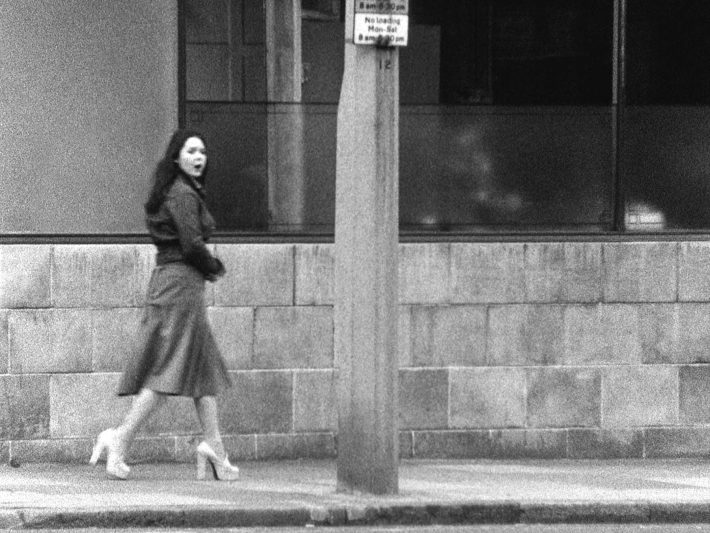
Our 2026 Festival trailer marks the 50th anniversary of John Smith’s classic film The Girl Chewing Gum.
“John Smith’s The Girl Chewing Gum is many things: a twelve-minute 16 mm film consisting of only two shots, a testimony to how complexity can arise out of a sparse economy of means, an allegory of cinema, a critique of documentary naturalism, an interrogation of language-image relations, a record of an East London neighbourhood, a classic avant-garde film, an art world hit some thirty-five years after its debut, and more besides.” (Erika Balsom)
Some filmmakers seem to construct worlds; John Smith has spent the better part of five decades demonstrating how easily the world, as we encounter it, is already constructed for us. Working from the streets, bedroom windows and incidental encounters of everyday life, his films often return insistently to a deceptively simple question: what, exactly, are we looking at and who is telling us how to see it?
It is perhaps in The Girl Chewing Gum that this impulse finds its most distilled form and where Smith’s grasp of cinema thrives, showing how language and image can fail to align, exposing not only the artifice of film but the authority of narration itself. He spoke with Open City’s Marketing Manager Laverne Caprice to reflect on the monumental piece 50 years on.
Laverne Caprice: The film, like many of your other works, is both conceptually rigorous and genuinely funny. How important is humour in disarming the viewer before or whilst revealing the deeper critique?
John Smith: I’ve always said that I don’t set out to make funny films, but I’m happy that the humour kind of arises and comes out. I’m fascinated by ambiguity, particularly with voice over. I’m telling you what an image means even if it doesn’t mean that but at the same time it’s not hard to imagine. For example, at the end of The Girl Chewing Gum, where I say; “this young man has just robbed the local post office and is attempting to appear inconspicuous,” it tells a story about this person that you’re seeing walking across the frame and that’s funny because we can easily imagine that could be the case if we saw that image in a different context. We know we’re being lied to because of the context of the film but at the same time, it could well possibly be true.
I’m also very happy that a lot of my films create humour, mainly because it makes them more accessible. I’m not interested in making films for elites, I want to make work that anybody that’s open minded can connect to and hopefully get something from the work. I deliberately make work where you do not need outside reference to understand what you’re looking at.
LC: In contrast, the serious undertones are also loud and clear.
JS: For me The Girl Chewing Gum is also a very serious film about documentary. It’s about the power that the word [documentary] has to suggest that images mean particular things. When I was making that film, I was very much thinking about how voiceover could be used in a kind of “dodgy” documentary to tell us images mean something different from what they are.
We see this in news coverage all the time, we see it in photographs where we’re shown things which are presented as evidence, where in fact, they’re subjective and sometimes downright lies. That was the kind of the function and part of the impetus to make the film.
LC: The audience is disarmed and required to believe what we’re being told, even if we can see that it isn’t quite reality. Do you remember any early media you consumed that was an inspiration for this filming style?
JS: Early media which stimulated me to make the film was François Truffaut’s Day for Night (1973), it’s a film about making another film. One of the things that really struck me when I saw the film were the exterior scenes which are shot at a studio, even kind of very spectacular things that look like they’re outside! In the film we see that everything is directed, including the extras in the film. I have to admit that although I’d been making films myself for three years at that point, I thought when you saw a feature film, it was shot in a real place, and these were real people passing by. I had no idea that everything was staged. I thought wow, the illusion of cinema is so strong to make audiences think that it is actuality. I thought why not make a film where everything really is actuality. In The Girl Chewing Gum, I don’t make any reference to anything to do with filmmaking at all; I don’t ask the camera to zoom in, I ask everything to come towards me. I never ask the camera to pan to the right, only to move to the right. I’m trying to draw attention to the illusion of cinema by denying its existence.
LC: You’ve spoken about the pleasure of coincidences–do you actively seek them out, or do they emerge through your way of working?
JS: They emerge through my way of working, mostly because I work on my own almost all the time. I’m in a situation where I can hang around and wait for things to happen! When you work with a film crew, you’re often on a strict schedule and working against the clock. I could sit around for 3 hours with nothing happening and then I could miss something. Things that come about by accident always end up being my favourite, in the film there are two which at first I was really pissed off about. The film was just one take which conceptually was important with one roll of 16mm film. When I got the footage back from the laboratory I noticed I zoom in on the clock the wrong way to begin with. It’s really jerky and I thought about how much that would annoy me whenever I show the film. I then remembered that I could direct the clock to move jerkily towards me on the voiceover, which I do. And of course, it follows my commands perfectly. The second coincidence is the man “robbing the post office” which only occurred due to a burglar alarm which consistently rang throughout the film. I decided to justify it with that final line about the robbery and the alarm still ringing. I wouldn’t have thought about that line if it wasn’t for the fact of the alarm. The alarm helped to suggest that maybe a crime had taken place.
LC: It’s been 50 years; you were a student then and throughout the years you have become a pivotal part of the world of non-fiction. You were conscious of engaging with and critiquing documentary traditions when making this film, has that stance changed over time?
JS: Not really, I went on to make a film called Hackney Marshes (1977), where I recorded interviews with people who lived in tower blocks in the area, it was commissioned for a TV documentary series. It’s the only kind of proper commercial TV documentary I’ve ever directed, and that was intended as a critique of documentary as well. I asked people about their experience of living in this place, and of course everybody had good and bad things to say about it. Sentiments of yes, there’s an amazing view but there are a lot of burglaries. I purposely include both opinions of the people; the film is intended to make it clear that I could have made a film about how great it is to live in tower blocks from the footage that I had but also how awful it could be. Normally, one would select one or the other depending on the ambition of the film whereas I presented both findings. It could be deemed as a bit cruel to the participants, because everybody seems to be contradicting themselves, but that’s reality. That’s what we do, our perceptions of the world are never cut and dry.
The Girl Chewing Gum is exploring the kind of politics of form, but I would say since the 21st century my films have been much more overtly political in terms of the subjects that I address but also because of how world events impinge on us. For example, post 9/11 and Britains involvement in joining forces with America and bombing Afghanistan in 2001, I kind of started to feel that this is really part of my daily life now. My country is involved in horrific war crimes against a civilian population, and as we know things have not gotten any better. Politics is on my mind all the time and I feel a responsibility to address things directly in the work. I also use tools like Instagram a lot, both to speak about my work but also topics such as Palestine. They’re not separate; these things are tied together.
LC: Have you found that this has affected how you engage with exhibiting your films, such as where you’ll go, where and how you show your work?
JS: It’s hard to know. Commercial galleries are certainly not engaging with my work as often! I have the privilege of not relying on my work to survive; I’m quite comfortable and don’t have enormous bills to pay. My work is usually self-funded; I’m not in the position like others where their lives and careers could be ruined by speaking out. There are also very well-known artists who are extremely rich and comfortable who aren’t saying a fucking word, and that makes me very angry.
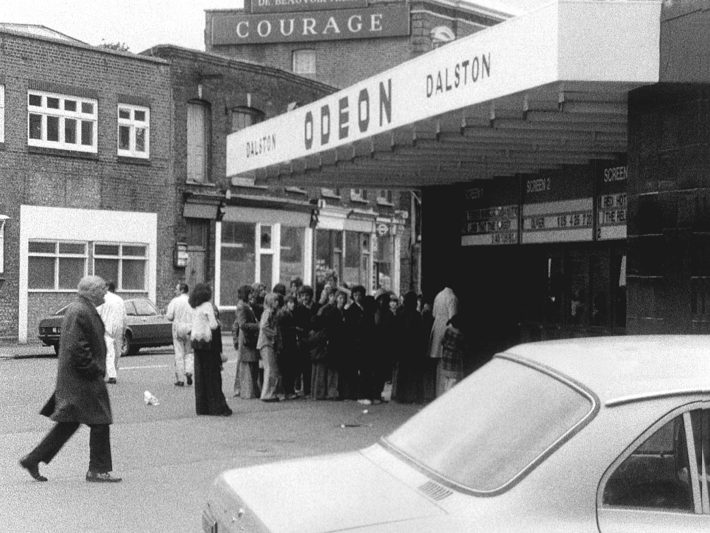
LC: You have lived and worked in East London throughout your career; my grandparents and parents also hail from the Hackney area, but the latter moved to Essex before I was born. I’m jealous! I feel nostalgic of an area I never really knew apart from going back to visit family. What does East London mean to you? And does that perception change between when you’re creating versus just living?
JS: I was born in Walthamstow, right on the edge which was considered Essex, so I am also an Essex boy!
It’s not purposeful that I make my films in East London, it just happens to be the place where I live. I’ve also made films in places I happen to visit. Such as my film Flag Mountain (2010) which was filmed in Nicosia, Cyprus – people asked me if I had a particular interest in the country and its politics, but it really was the surrealism of the flag lighting up at night. I ended up making a film which is about nationalism, or a film which suggests ideas of nationalism, but it was only because of an accident.
I like to film in East London partly because I don’t like to film in places I don’t know; it can become quite uncomfortable; especially as I film alone most of the time. I’m often at my house or looking out the window because it’s a more comfortable way of working.
LC: Do you think the film gains new meaning in an era where reality itself is often mediated, curated, or algorithmically shaped? Do you think today’s audiences who are used to misinformation and media manipulation read the film differently now? Does the film resonate differently in an era of AI, deepfakes, and misinformation?
JS: Absolutely, for lots of different reasons. I think one of the reasons that the film’s still really popular is to do with the unreliable narrator, which was a term that I’d never heard of until over a decade ago. It has a particular kind of standpoint and often the interest will kind of come and go. I always say to people, even if people don’t like your film at the moment, keep showing it, because maybe they will in the future.
When I made The Girl Chewing Gum it wasn’t that popular amongst the kind of London Film-makers’ Co-op world that I inhabited mainly because it was humorous. People probably thought it can’t be serious because it’s got humour in it and I’ve always felt that humour is a serious thing, but not everybody would agree with me. With it being 50 years on, the film could maybe trick people because it looks like ancient history, that area does not exist in the way it looked then, today. When you look at the people, the demographic’s entirely different. When I first lived there back in the ’70s, I thought it was a very multi-racial area, but then you see that there are only probably six black faces in the whole film.
I remade the film in 2011 and called it The Man Phoning Mum and superimposed the new material on the old whilst simulating the same camera movements. I secretly hoped someone from the original film would walk past and meet their former self. I saw people’s behaviour in the street had changed, people were looking at me suspiciously and one particular bloke walked past the camera closely and then came back immediately and screamed profanities at me and asked whether I was filming him. There is so much more of an awareness now, even things such as surveillance cameras didn’t exist in 1976. Back then people questioned the ethics of filming people and then ascribing characters on them which of course is very reasonable, nowadays all those people would be on several different cameras within 5 minutes.
I do think people’s perceptions have changed a lot over time with how much technology there is now. It’s great to talk about it even after 50 years… it does make me feel quite old, given that I still haven’t decided what I’m going to do when I grow up.
Since 1972 John Smith has made over 60 film, video and installation works that have been shown in cinemas, museums and art galleries around the world and awarded major prizes at many international film festivals. Known for their formal ingenuity, subversive wit and oblique storytelling, his films blur the perceived boundaries between documentary, fiction, representation and abstraction, playfully exploring and exposing the language of cinema. Retrospectives of John Smith’s films have been presented at international film festivals in 16 countries. His recent solo exhibitions include Secession, Vienna (2025); Kate MacGarry, London (2025) and Kunstmuseum Magdeburg (2022). Smith received a Paul Hamlyn Foundation Award for Artists in 2011, and in 2013 he was the winner of Film London’s Jarman Award.
You can watch the trailer here.