Announcing full programme of 2026 Open City Documentary Festival

Open City Documentary Festival 2026
Open City Documentary Festival is excited to announce the full programme for its 16th edition, taking place in person from 14th to 19th April. Throughout the week we’ll be screening 125 new and historical films across London at our venues Barbican, Bertha DocHouse, BFI, Close-Up Film Centre, Institute of Contemporary Arts, and Rich Mix, where the Festival Hub will be based.
Opening and Closing Nights
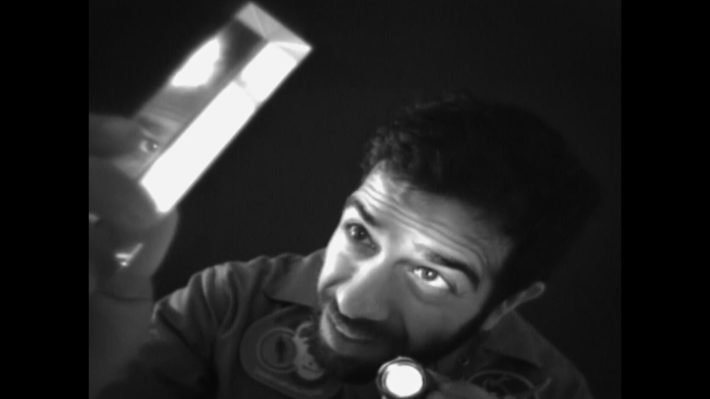
The 16th edition of the festival opens with the first of two programmes dedicated to Armenian filmmaker Artavazd Pelechian, one of the greatest montage artists in modern cinema. His films uniquely combine documentary footage from official archives with images shot by the filmmaker himself and his collaborators. Assembled through what he conceptualised as “distance montage”, his films defy traditional distinctions between documentary, fiction and the essay film. The programme Interstitial Cinema: the films of Artavazd Pelechian offers a rare opportunity to see this work in the United Kingdom.
The festival will close with Graeme Arnfield’s second feature The Case Against Space (2026) which depicts, what appears to be, the first organised strike beyond Earth’s orbit. The film reconstructs the events of the 1973 Skylab 4 mission in protest against the pressures and working conditions aboard their space station. It will screen with Marta Popivoda’s SLET 1988 (2025), which features dancer and anti-Milošević activist Sonja Vukićević as she moves through socialist-modernist spaces, her body echoing Yugoslavia’s last mass performance.
Wider film programme
The festival will present special programmes In Focus: Onyeka Igwe, Ken and Flo Jacobs: Seeing Through Film, Interstitial Cinema: the films of Artavazd Pelechian and Archivistas Salvajes presents Los Subterráneos: Cuban Amateur Cinema.
The importance of Black filmmakers and viewers of Black cinema will be discussed in Analogue in Depth Seminar: “Why black filmmakers should shoot analogue”, an event devised by Jennifer Lauren Martin. The accompanying screening features a selection of works by black artists and filmmakers engaging with analogue film not simply as a medium, but as a deliberate aesthetic and political strategy.
The London Community Video Archive presents a programme of new short films by emerging filmmakers from across the UK. Developed through an open call, this selection is made up of creative responses to the LCVA’s rich heritage.
A screening organised by Ricardo Matos Cabo focuses on the work of Tomiyama Taeko (1921-2021), an artist whose socially engaged practice occupied a distinctive place in postwar Japanese art.
Listen With Your Eyes, the ongoing series of screenings for children of all ages and their grown-up companions, returns with a live cinema performance by Guy Sherwin and Lynn Loo. Organised in tandem is A Roundtable on Family Cinema which brings together personal and collective experiences on film, family, and the idea of “family cinema.” Four practitioners working in the field of film – Maria Anastassiou, Sophia Satchell‑Baeza, Rehana Zaman and Hyun Jin Cho – will open the conversation with their own reflections before inviting a wider discussion.
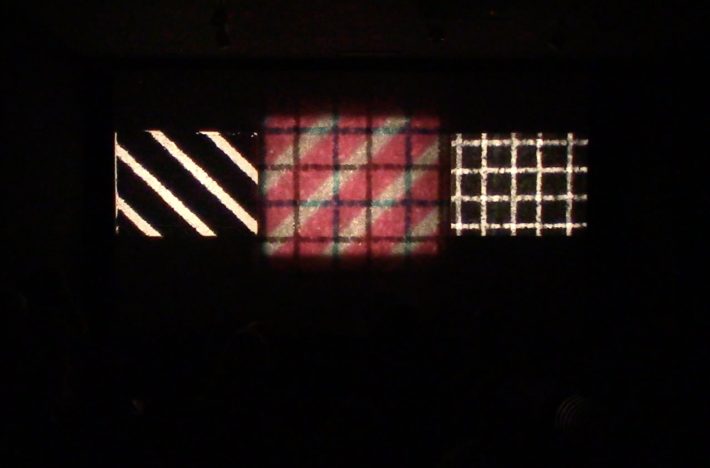
The classroom is your set led by Niki Kohandel and Nia Fekri, will present methodologies used by moving-image artists working across schools and educational settings.
The Radical Film School is a free programme for artists dedicated to film as political action. They will take over the Talks space with Letters to a Revolutionary for an afternoon workshop in solidarity with prisoners in the UK.
BFI Doc Society and LUX will present an open conversation with artist Suneil Sanzgiri, who also has two works screening at the festival, about the ecosystems of support for artist’s non-fiction moving image and cinema. There will also be a session of industry roundtables designed to help filmmakers and other film professionals connect with industry experts will take place with partner organisations FLAMIN, T A P E Collective, the New Black Film Collective and the British Council.
The Ian White Lecture returns with a performative lecture by Jordan Lord, who will show a version of their new short film Concealed and Denied, an archival film without archival footage that concerns how right-wing propaganda weaponises mainstream media as well as documentary film and its funding structures.
The festival also includes new works by Abdellah Taïa, Andrea Luka Zimmerman, Ann Carolin Renninger & René Frölke, Anthea Kennedy & Ian Wiblin, Basma Al-Sharif, Darryl Daley, Edward Lawrenson, Graeme Arnfield, Jennifer Lauren Martin, Jenny Brady, Juliette Le Monnyer, Kevin Jerome Everson, Kim Torres, Laida Lertxundi, Liz Roberts, Lonnie van Brummelen, Siebren de Haan & Tolin Erwin Alexander, Lucas Kane, Lucy Harris, Maria Oblicka & Alexander C. Trigg, María Rojas Arias & Andrés Jurado, Marta Popivoda, Marthe Peters, Maureen Fazendeiro, Miko Revereza, Miranda Pennell, Onyeka Igwe, Peter Treherne, Saeed Taji Farouky, Sanaz Sohrabi, Shayma’ Awawdeh, Sky Hopinka, Sophie Sabet, Stanley Schtinter, Suneil Sanzgiri, Sven Augustijnen and Viktoria Schmid.
Expanded Realities
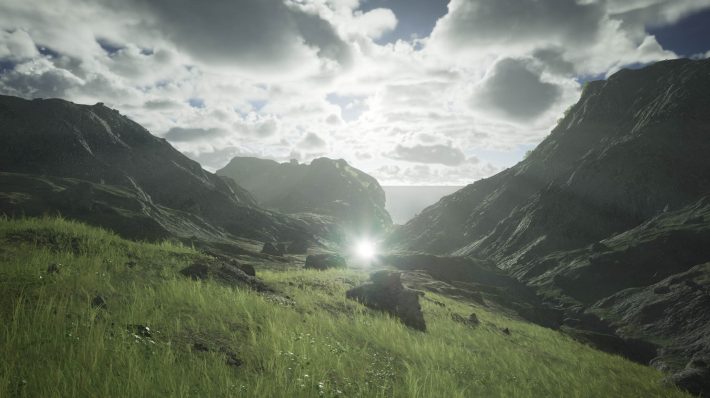
This year’s Expanded Realities exhibition, A Sense of Space, brings together projects which explore the relationship between our senses and the environments around us using a range of media including VR, audio, installation and video games.
Constantinopoliad and Peace of Mind make use of audio to untangle the ways in which the creative process is shaped by the people and events around us. Friends, lovers and family members become inspirations and collaborators, be it in the poetry of Cavafy or the first cut of a song. Both projects make the case for the process of making art being porous, always evolving in response to the people and places in which it is taking place.
Alice Bucknell’s projects, Earth Engine and Ground Truthing, and Kris Hofmann’s Out of Nowhere explore how our rapidly-changing climate is shaping the ways in which we make sense of our environments. The works call attention to what we notice and how we notice it when interacting with the landscapes around us. Whether it is through running our hands along a floodplain or the development of AI, satellite and digital modelling, Bucknell and Hoffman’s works ask us to consider if the transformations in our ecology may need us to transform how we understand our relationships with the planet.
Find out more about the full programme here.