John Smith on Being John Smith

By Oliver Dixon
‘Culture is ordinary: that is where we must start’ – Raymond Williams
John Smith is both ordinary and unique. The artist-filmmaker holds the most common name in the anglophone world and yet, to many, he is the John Smith: ‘one of the most famous experimental filmmakers in the world’, to quote a festival catalogue he reads from in his Hotel Diaries video series (2001-07). To those unfamiliar, Smith’s films – from the classic early work The Girl Chewing Gum (1976) through to the Covid Messages series (2020) – make strange the familiar. Smith’s work consistently foregrounds the construction of cinematic narrative, the psychic role of associations and slippages, and the peculiarity of everyday life on his doorstep, all with the dry wit that has become his trademark.
Smith has always been both part of and distinct from the orthodoxies of his times. Many critics have remarked on his idiosyncratic take on the lessons of the Structural/Materialist school of filmmaking. Primarily associated with the London Film-makers’ Co-Op, and filmmakers like Peter Gidal and Malcom Le Grice, Structural/Materialism emphasised the material of the film medium itself: an emphasis on film grain, light, sprocket holes and the reel, aimed at a ‘demystification … of the film process’. In the 1970s, Smith was tutored by Gidal at the Royal College of Art and Le Grice screened his early works at the Co-Op.
Like his mentors, Smith questions the visual construction and illusory power of cinema yet does not, as Gidal sought to do, refute or absolutely reduce documentation or representation. In The Girl Chewing Gum, for example, a voice directs people who are ostensibly actors as they move in and out of a long shot of a Dalston street. Yet as the shot goes on, the voice’s instructions become progressively absurd before a reveal that shows that the speaker is in fact ‘shouting into a microphone on the edge of a field near Letchmore Heath’. The ‘actors’ in the Dalston scene are, in fact, members of the public going about their daily business. But even the truthful stability seemingly offered by verbal confirmation of the speaker’s real Letchmore location soon dissolves into folly as the speaker claims to see a man with a ‘helicopter in his pocket’. Such humorous moves are typical of Smith’s drive to undercut the illusory truth of filmic constructions while retaining an interest in the power of the image to capture and distort our understanding of the world.
As Erika Balsom writes, considering Smith in relation to the Structural/Materialist tradition enables us to situate his work ‘within the broader field of discourses and practices from which it emerged and in which it was first encountered.’ Indeed, his films’ enduring power points to the value of an artistic context developed within a larger project of developing a political aesthetics and cinematic infrastructure. Experimental work needs discursive and institutional fields to position itself within and against. The autonomous institutional space of the London Film-Makers’ Co-op created an oppositional community in which Smith could work. The Structural/Materialist dogmas enabled him to stake out his own idiosyncrasies against the avant-garde orthodoxy. Rules are there to be broken, after all.
Yet, John Smith’s uniqueness emerged out of the ordinary, common contexts of the early 1970s: a time when higher education was free, student occupations reigned, Marxism was prevalent in the academy, radical squatting organisations were plentiful, and a cinematic avant-garde was on the ascendancy in England. Without the accessibility of art college for school dropouts, the radical ‘70s milieu and the usual concoction of luck, chance and serendipity, John Smith might have been just one of the thirty-thousand other citizen Smiths. Thankfully, instead we have the John Smith. But the shifted terrain of experimental cinema in the decades since Smith’s emergence – a relative detachment from broader theoretical and political projects, the dire state of funding, the marketisation of art schools and the subsumption of organised working-class subcultural resistance – might leave us to wonder if another ordinary, unique John Smith could emerge in 2025.
From the angle of self-deprecating autobiography, rather than my much stuffier biographical tone, Being John Smith, the artist’s latest work, playfully explores the commonality and uniqueness of his name and life to date. At his home in East London, we sat down to discuss this beautiful film and trace, through its images and form, a broader history of which Smith is but one unique part.
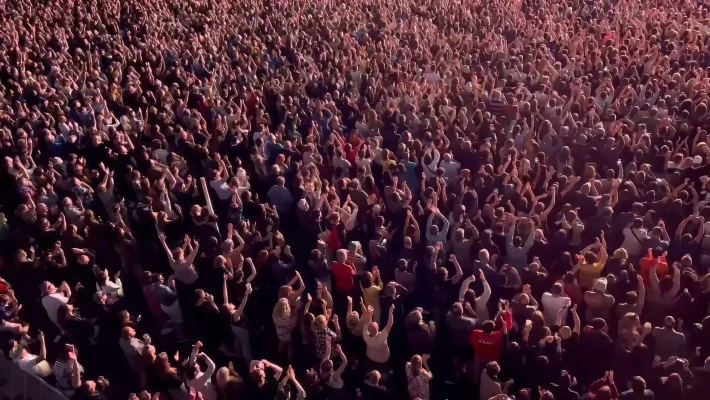
The crowd at a Pulp concert in Being John Smith (2024)
Oliver Dixon: How did Being John Smith begin?
John Smith: With the last shot. I shot that footage at a Pulp concert. I didn’t attend with the intention of filming anything but, looking down on the crowd, I saw this amazing group of people jumping up and down communally, celebrating commonality. It’s just a very important thing for us to share what we have in common as human beings rather than thinking about our differences.
I was intending to make a film that was completely abstract. I had taken lots of similar shots of the crowd from the same position. I thought I might overlay these bits of video and overlay different parts of Pulp’s ‘Common People’. I wanted to gradually peel away the layers and reveal the reality. When I tried to do it, I wasn’t happy with how it worked. Not least because even if you’ve got ten layers of Common People, one on top of the other, out of sync, the audio still sounds like music.
I thought, oh, what a shame. I really wanted to use that view. And then I’d been thinking since forever about making a film about my name. So, because they’re singing ‘Common People’, I thought, what about the Pulp concert being the last shot of that film? All those people are basically losing their egos and celebrating the joy of being in a crowd and doing something together. The shot suggested ideas of anonymity and individuality, which obviously relate to how I discuss my name in Being John Smith. It seemed an ideal ending for a film. I hadn’t made a film before where I knew what the end was going to be at the start.
OD: What other material did you have to work with?
JS: I have masses of photographs from my father who was a keen amateur photographer. I’d like to make a different film about him one day because I don’t really credit him enough in my films. I’m worried that he comes across as a rather uninteresting bloke, but that’s not right. Amongst other things, he was a very good photographer. He gave me my first camera when I was about eight and got me interested in photography.
I’ve known for ages that I want to make a film based on these photographs. I didn’t actually use many in the film because I didn’t want to make an illustrated autobiography. Although it starts off feeling like a straightforward autobiographical film, the idea is that it expands into areas that we can all relate to.
OD: How did the on-screen text come about? On the one hand, the voiceover is mostly a narration of your biography; on the other, the written captions undercut this narration, undermining both the artifice of the voiceover, but also injecting moments of vulnerability. You doubt the film’s strength, question the sound of your voice after treatment for cancer and condemn the genocide in Gaza.
JS: It came about very organically because I did actually think a minute and a half into the film: It’s a bit conventional, isn’t it? How do I liven this up a bit? At that point, I thought, I’m going to introduce these images of the covered buildings [the film is interspersed with images of scaffolded buildings and construction sites covered in white tarp] because I wanted to introduce an element which, at least to begin with, didn’t have any logical explanation. It’s really that doubt you have when you’re making a film thinking, is this idea worthwhile? Is it going to be any good? So I introduced the caption that says: ‘I’m starting to worry that this film is going to be too conventional’.
Although it’s not a straightforward dialogue between egotism and negativity, it roughly follows along those lines. Nearly all the captions are about doubt. Doubt about one’s own self, about the future of the world, and whether it’s worth making films. But I find it quite amusing because sometimes people say to me, ‘You needn’t worry about the film. It’s actually pretty good’. Of course, I think it’s fucking brilliant. It’s just that at a certain point in making it, like most artists, I had doubts about the work. One day you think you’re a genius, the next thing you think everything you do is crap. Most days are in between.
OD: This sense of massive historical change and anxiety about such change pervades Being John Smith. It is deeply concerned with fading memories. In the voiceover, you express worry about the quality of your family archives, the gaps in your memory, and a distaste with the idea of artists building their archives in the current moment. The film is also peppered with references to the history of your own work, particularly The Black Tower. That titular haunting structure appears in another form in this film with the inclusion of those images of white tarpaulin covering construction sites in East London. Their rapid intrusion over the montage expresses further anxiety emerging from these new constructions. I wondered if this signalled towards the process of gentrification.
JS: You got it. Those constructions are everywhere. The reason they’re in the film is because I found it so strange that these things were appearing all the time. The process of gentrification in this area [East London] is unbelievable. It has completely changed. Lots of artists used to live here but not anymore. Artists and social workers have been replaced by bankers and people in finance. They might be quite nice people, but they are bankers. People buy these houses, completely do them up, stay for five or six years and then move out. Somebody else moves in and guts them again. It’s obscene. That’s the visual politics of the film, anyway, because, as we know, people are getting poorer while others are getting richer.
I’ve taken quite a lot of photographs of those construction sites. Originally, I wasn’t thinking in relation to a film. I was just curious about this virus of covered buildings. Then I thought, I like these images, they’re sinister. I’ll introduce them into the film. It hadn’t occurred to me to make any mention of The Black Tower in the film until I decided to include these construction sites.
I’m quite interested in how one thing leads to another in script writing and in editing. I like to create a thread that runs through a film from beginning to end and enables you to bring as diverse a number of ingredients together as you can. For example, the fact that my dad’s middle name is Lyle leads to Tate and Lyle, leads to the Tate Gallery, leads to The Black Tower. I really like those things being chosen for me through the power of association.
OD: In both this film and Hotel Diaries, and indeed in the COVID Messages series, the ordinary is punctuated by a deeply tragic political context, as if to point to the repression of those contexts that invisibly undergird the ordinary. How do you see this role of political content in your works?
JS: I guess since the beginning of the 21st century, politics and the consequences of political decisions have become much more dominant in one’s experience of daily life. I think about those things more than I used to. I find it hard to avoid thinking about them like I used to be able to, to some extent. Because most of my work is based on personal experience, politics are much more present in my films. I guess I can trace this back to 9/11. That was the beginning of it, because the impetus for the Hotel Diaries videos was really to do with the horror of my own country’s involvement as an ally of America and bombing Afghanistan and Iraq. In the Hotel Diaries videos, when I looked at an object it often reminded me of something which connects to either contemporaneous conflicts or historical ones. So similarly, in the recent film, it’s very important to me that I included the caption that says, ‘Stop the Genocide, Ceasefire Now’.
When I’m working on a film, I might listen to the news or read something. The news pervades our consciousness all of the time. I made a vow only a couple of months after the killing started at the end of 2023 to say something about the genocide whenever I showed my work. When I was making Being John Smith, I thought, I’ll put it in the film so, even when I’m not there, people will be exposed to it. And, of course, it’s deliberately a surprise that this text appears. Anybody looking at the film can see where I’m coming from. If they don’t like it, they can fuck off.
OD: You’ve suggested that a turn towards the insertion of political content happened for you in the 21st century. But I think many people, myself included, would consider your films prior to that to be politically charged, especially in their undermining of filmic construction. Elsewhere, you denoted this ‘encouraging the viewer to think about the outside of the frame’. How do you conceive of the political implications of film form and how does this carry across to Being John Smith?
JS: The politics of form comes out of the time I started making films, when ideas around structural film in London Film-Makers’ Co-Op were very prevalent. I was mentored by people by virtue of working there. And, at that time, the Royal College of Art [RCA] was interesting because the film school had a wide range of students, from people who were making agit-prop political films to people who came from fine art courses, and others in between. The main tutor there was Peter Gidal, who was very influential on me. Ideas around Bertolt Brecht, like the notion of distanciation, were also very prominent. And semiology of course. But I didn’t go into the hardline, structural thing, where you could never have any sense of narrative, or even representation, in your films, which is what Peter Gidal’s work was about – really to the extreme. But, from the start, I took some of these ideas on. It was a very formative time in my life. I was young when I made The Girl Chewing Gum. I’ve stuck with that. Whenever I make a film, it’s really important to me that it draws attention to its construction.
OD: Why do you think you held onto narrative?
JS: Partly because I love playing with the determining power of the word, which I discovered when I made The Girl Chewing Gum: the idea that, even though we know we’re being lied to, we still have a half-wish to believe. If you’re told that this boy has just robbed the local post office and has a gun in his pocket, you know it’s not true, but you can imagine it to be true.
The other thing is that, when I was at art school, many of my friends didn’t go into higher education at all. I wanted to make films that they could appreciate just as much as my peers and tutors at college. It has always been important to me to make things more accessible than a lot of the things that were around me. I don’t want to make films for elites. I really want them to be for anybody who’s a bit open-minded. I hope that, if you’ve trapped an audience in a room, they’re going to tune into the work.
OD: Actually, Sophia Satchell-Baeza told me this anecdote. You were in Newcastle and there was a screening of some superhero film. The screening was sold out and so some people were redirected to a screening of your films. Were you in the room?
JS – Hotel Diaries toured a lot of Picturehouse cinemas. And it took me a long time to get the audience figures. And, when I got them, I realised why: because the cinemas were empty. But then, when I went to Newcastle, it was absolutely full. I thought: my films are very popular in Newcastle. At the end I did a Q&A and I asked if anybody had any questions. And this guy put his hand up and said, ‘Well, I don’t really have a question, but just a comment. I came here to see Batman Returns but it was full. I couldn’t get in. I could get in here. So I came in here. But thank you very much. I really enjoyed it’. I asked the audience, ‘How many people came to see Batman Returns?’, and 95% raised their hands. But we had a really good Q&A. I was so pleased because Hotel Diaries is probably one of my most difficult films, in a way, certainly if you’re impatient. It’s very slow. I was really happy. It gave me confidence in what I’ve always believed in: that if you can actually get an audience to sit down and look at stuff, people are a lot more broad-minded than exhibitors and producers think they’re going to be.
OD: In Being John Smith, you mention that you’re being drawn more and more to the left every day. Did you have any other early left-wing influences?
JS: I was 17 in 1969, when there was a lot of alternative culture. There were lots of organisations that were based in squats, which were charitable in one way or another, or offered information. For example, there was an organisation called BIT which was a free service based in a derelict squat in Notting Hill. Their phone number was freely available. Anybody could phone them and ask them a question, about absolutely anything. It was like a precursor to the internet.
But, throughout my adult life, almost everybody I’ve come into contact with and respected has been on the left. I was also pretty influenced when I went to North East London Poly. Several of the staff had been thrown out of Hornsey after the sit-in in 1968. Then at the RCA, the staff and the students that I gravitated towards were very much on the left. Lots of people were really into Godard. I was very lucky in terms of other students, particularly at the RCA, in terms of developing a political consciousness.
OD: In terms of the art school context, you have described a radical subcultural milieu of the late 1960s and 1970s. At that time, of course, university was free. You worked as a lecturer for many decades. Have you seen a shift in the art school environment since then? What is the context like for artist-filmmakers now and how has their class makeup shifted?
JS: Don’t start me on this. It’s absolutely transformed. To begin with, the staff-student ratio has changed phenomenally. I think when I first started teaching, it was about eight students to one member of staff. When I left, it was sixty to one. In my last few years of teaching, there was no way I could get to know the names of all the students. From my own perspective, what I like doing is one-on-one tutorials with people, which became more difficult and more infrequent as time went on because of how stretched things have become.
One thing I liked about teaching at the University of East London was that a lot of the students came from the local area. There were lots of working-class kids who were maybe not all that confident, but just really into making art. I taught there and I taught at Central Saint Martins. When I decided to cut my time down, it was a bit of a no-brainer to leave Saint Martins because it’s mostly full of privileged kids. But now, I think that’s the case with most places.
I find it very upsetting because I could never have gone to art school without the financial support that you got at the time. My parents’ dictum was ‘never a lender or a borrower be’. They never had a hire purchase agreement. It horrifies me that people leave art school owing so much money. People come to do a fine art course and, from day one, they’re thinking about what they’re going to do after. Or if they can even make a living as an artist.
I went to art school because I didn’t want to get a job. I thought, I’m basically getting a grant. I’m being paid for doing something I like. Now, things are very different.
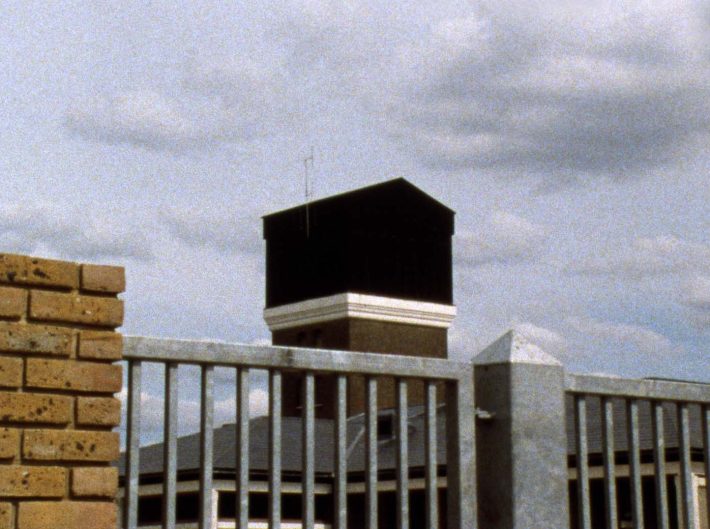
Still from The Black Tower (1987)
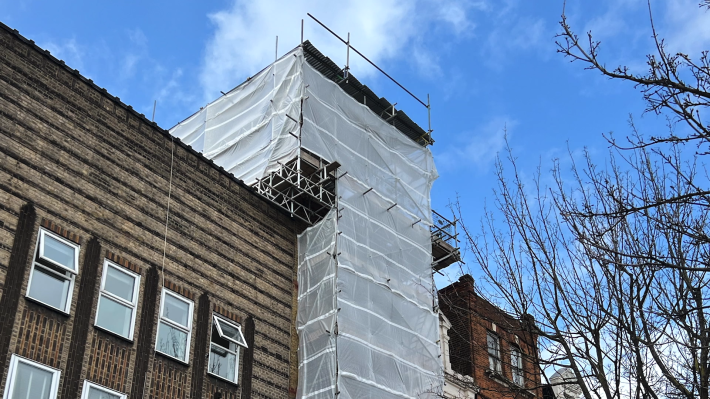
Still from Being John Smith (2024)
OD – Are you nostalgic for the past: free art school, the radical milieu of the ’70s?
JS: I don’t want to seem too negative. But yeah, we’re fucked. I can’t believe it. I grew up in a time of optimism. We young people were going to change the world. I hope there’s still that optimism among people involved in Just Stop Oil and other direct action groups. I’m lucky enough that I’m not going to be around that much longer. Because can you see it? It’s the death throes of capitalism. I can’t see how we can get out of it. The people that have interest in capital and property would rather destroy the world than lose their wealth or resources. And all of us are so dependent on stuff. I mean that’s what’s so extraordinary about thinking what it must be like for people in Gaza. Because we’d be fucked if we have a power cut.
OD: In the past decade, there has been a resurgent interest in those political and artistic movements of the 1970s that you described. Is there something valuable in that return?
JS: As long as it’s not too nostalgic. I think it’s very important to remember the difficulties. At that time, there was an organisation called the Independent Filmmakers Association. Like many organisations on the left, the members all hated each other. [Laughs]. I’m exaggerating, but it wasn’t all peace and love between us. As always on the left, there was a lot of heated debate, shall we say.
I think it’s better to reinvent things than to go back to them. What’s great now, certainly with the film community, is that it’s so easy or cheap for people to own video projectors. Pop-up cinemas are two a penny, or can be. There are so many events that are not-for-profit and come about through pure enthusiasm.
OD: To end, I want to ask about the ordinary or the common – just as Being John Smith ends with an invocation of the beautiful ordinary found in the performance of Pulp’s ‘Common People’. In ending with that performance of ‘Common People’, the film appears to momentarily celebrate this commonality, and yet the caption that follows this moment expresses doubt about its suspiciously affecting tone.
JS: It is one of few moments of optimism. But it works too well. It’s too good an ending.
Everybody’s clapping at the end of the film. It’s a cliché. I was uneasy about that, but I thought, I’m going to do it anyway because it’s such a good way to end the film. But it was handy to be able to express those contradictions.
I think there’s a lot in the ordinary that we can appreciate, but I’m not sure I’m celebrating the ordinary. I’m certainly using it as a stimulus for the work. I really like working with subject matter that’s on my back doorstep. There are so many possibilities, so many things we could make films about. I generally get ideas from something I see on the street. The films are relatively ordinary just because they’re to do with things that I notice and me thinking, ‘that could be interesting’.
But I think I neither celebrate nor dismiss the ordinary. I think it’s important, but what is ordinary? That is the question.
This interview was conducted during Open City Documentary Festival 2025 in the framework of the Critics Workshop with Another Gaze.