Diana Allan on Partition

By Ella Slater
Diana Allan’s Partition (2024) is ostensibly historical but deals with an event and its perpetuation: the 1948 Nakba. It is the transgenerational, psychic state of ‘partition’ – a term which refers both to the United Nations’s 1947 Partition Plan and the displacement of Palestinians – that Allan seeks to convey with her most recent moving image work. She does so through the considered use of silent footage gathered from a British colonial archive (intentionally unnamed), as well as the asynchronous contemporary oral testimonies of Palestinian refugees. Partition is a lyrical reckoning, both with imagery that is beautiful and imbued with violence, and with the Western narrative that posits the implications of British involvement in Palestine as situated in the past, rather than inseparable from the ongoing genocide in Gaza. As Allan illuminates, the Nakba is a continuous process and a state of existence.
Partition begins with an inky black screen, over which a lamentation in Arabic is sung. It addresses memory and the sea’s unceasing rhythm, in an act of mourning for a lost loved one. The film’s optic darkness is perhaps symbolic of that which cannot be represented, or has been erased through colonial narratives; that which, according to our narrator, is witnessed only by the waves. A telescopic view of Gaza’s hills appears and, from here on, we are confronted with a montage of footage filmed by, and sometimes depicting, British army units. Their on-screen marches and mechanical movements stand in chillingly stark opposition to the vitality of Palestinian almond groves and village markets depicted in other fragments. The texture of deterioration inherent in these images makes us distinctly aware of the time that has passed, though this is complicated by their auditory accompaniment: the fragmented contemporary testimonies of Palestinian refugees, which speak of the Nakba’s continued repercussions. British soldiers once narrated the contours of Gaza through their film cameras, while these oral histories – tales of both great pain and strength – deconstruct the authority of the colonial archive. Such authority has long been refused to the Palestinian people.
This is a film that emphasises the radicality of sound through its non-diegetic nature; its sonic elements transform the way in which we perceive its imagery, thereby making discernible the fraught politics of witnessing. Indeed, much of Allan’s career – as an anthropologist and ethnographer, as well as an artist – has insisted on oral testimony as a resistant and recuperative act. She has documented stories of Palestinian displacement in Lebanon for over two decades and, in 2002, co-founded the Nakba Archive: a grassroots oral history collective dedicated to collecting the experiences and memories of first-generation refugees. Throughout its operation, the Nakba Archive has filmed over 500 interviews. Taken together, the intensely personal nature of these videos constitutes a collective consciousness of life. In the introduction to her book, Voices of the Nakba: A Living History of Palestine (Pluto Press, 2021), Allan asserts that ‘worlds rematerialize in description’; in other words, embodied narratives foster embodied understanding. It is the remedial potential of ‘re-materialisation’, both physical and conceptual, that underscores the emotional force of Partition.
Allan’s previous works include the ethnographic films Shatila, Beirut (2001), Still Life (2007), Terrace of the Sea (2009) and So Dear, So Lovely (2018), which, like Partition, are concerned with the intricacies of archival truth, refugee camp environments, and the aesthetic – as well as material – implications of exile. Through her sustained presentation of the trauma of the Nakba as entwined with everyday existence and the refugee psyche, Allan shifts the representation of Palestinian life away from the overdetermined and singular proximity to death with which it is often portrayed in the Western media. Partition is part of a larger umbrella project continuing this subversion of imperial authority. ‘Living Archives’, a branch of the Nakba Archive, hosts creative workshops and collaborative projects in camp communities, some focused on film production, others on music and storytelling.
Allan’s practice treads a line between art and activism. It is a line that feels important to address in the context of the genocide in Gaza, the portrayal of which, in the popular media, often blurs the line between raising awareness and perpetuating stereotype, between sensationalising and documenting. Indeed, many criticise the very act of bearing witness, arguing that recognition cannot make for meaningful justice or compensation, or that the recantation of trauma can be significantly painful for those affected by it. These things may be true, but they do not discount the radicality of reclaiming lost narratives, and recognising one’s own culpability in continued violence. As many of Allan’s testimonies acknowledge, sharing personal histories through creative means can also be deeply validating – healing, even. Each singular record contributes, in some way, to a wider collective consciousness of Palestinian refugee experience.
At one point in Partition, there is documentation of a village procession. A young girl emerges from a crowd of veiled women, her face half obscured by shadows but her eyes gazing fixedly and determinedly at the camera documenting her. The voiceover, which drifts between personal recollections and commentary on the images appearing on-screen, directly addresses the child. ‘How beautiful she is’, speaks the narrator, ‘I will call her Meiroun, after the village from which my grandfather was displaced’. In this singular fragment, one of many such moments within the film, linear time collapses; the past becomes inextricable from the present, individual inextricable from collective. As the fog subsides, we may be reminded of Britain’s continued disavowal of its role in the devastation which prevails today. We might ask, as Donna Haraway does, ‘With whose blood were my eyes crafted?’ Partition is a testament to the restorative power of testimony, and the collective radicality of a singular voice.
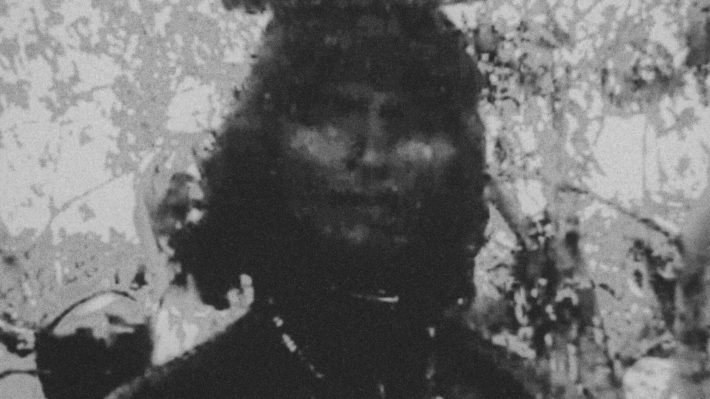
Partition (Diana Allan, 2024)
Ella Slater: Why is it important to continue making films against the ongoing Nakba and the genocide of Palestinians in Gaza?
Diana Allan: At Harvard, where I did my doctoral studies at the Sensory Ethnography Lab, I was mentored by Lucien Castaing-Taylor [whose filmography includes Sweetgrass (2009) and Leviathan (2012)]. Doing fieldwork during this time, I began to think about film not only as an illustration of text, but as another medium for ethnographic inquiry. There are many things that can be captured on film which can’t be in text, such as affect, materiality, and the ontological richness of a place. It’s also an incredibly powerful medium for raising awareness. There are now a huge amount of films about the Palestinian predicament, to the extent that I think there has become almost a predetermined visual grammar for its representation. As I see it, my own work does something different, through the decision to experiment formally: to play with translation and text, to raise questions about what we think of as semantically loaded, what we don’t, and why. My films are not mainstream documentary, but they push against historically and politically overdetermined representations of Palestinian life, which is important.
ES: I’ve been thinking about the ways in which we consume these transient, digital images of crises, and the ebbs and flows of attention which events such as the Nakba receive through cycles of the Western media. In its lyrical, analogue nature, Partition seems to be the antithesis to this. Was this something you were concerned with when making the film?
DA: I made Partition because I was interested in British responsibility for the Palestinian catastrophe, which Britain is yet to fully acknowledge. The grotesque spectacle of Israeli violence has served to deflect critical scrutiny about British culpability and responsibility in this long history of Palestinian statelessness, displacement and dispossession. It felt important to return to this deeper history, as well as the extractive colonial encounter more broadly. Reshooting digital materials in analogue and intervening in the image – through reframing, for instance – was a way to question the temporality of the archive. It also underscored the way these images speak not just to the past, but also to the present. These images are animated and remade through the sound recordings that accompany them, which I created with Palestinian friends and collaborators in Lebanon. This dialectical structure – in which Palestinian interlocutors speak back to the images – makes evident the footage’s ongoing significance to the current condition of Palestinian life. The deluge of digital images that document every moment of Palestinian suffering in Gaza, in the West Bank and in exile, is something I’ve tried to question through the choice not to reveal the identities of the voices we hear. This was a refusal of the constant surveillance of Palestinian life, which has come to seem so violently dehumanising, and also a subversion of the assumption that everything should always be available to foreign audiences for consumption. We need to rethink the terms of access.
ES: I understand that you re-shot the colonial footage of Partition manually, on 16mm film, in an explicitly physical act of ‘re-materialisation’– a word you’ve used a lot in relation to your work.
DA: The decision to re-shoot the material in Partition on film was precipitated by the exorbitant cost of the copyright, held by the imperial institution which I found the footage in. For ethical reasons, I didn’t want to be paying a British government institution to make a film which is, at its core, about its dispossession of Palestinians. Eventually, as is often the case, the constraint became a gift, since it provoked a completely different relationship to the material than I would have had if I had simply dropped some files onto a timeline. It took a very long time to reshoot all of the footage I wanted to use, and it involved learning new processes, with the help of Erin Weisgerber and Elian Mikkola [both Montreal-based experimental filmmakers]. Hand processing allowed me to forge an intimate relationship with the material, and the fact that I was sitting with it for such a long time became important to the film. In the process of re-materialisation, thinking about the antagonistic relationship between copyright and the ‘right to copy’ became very generative for me, both aesthetically and intellectually; the question of fidelity was no longer my concern. We were shooting low-resolution footage from files that we had ripped, and the pixelation took on the quality of pigment, or paint. I think that the lack of resolution produces its own kind of clarity: one which allows for other ways of relating to, or perceiving, these colonial images. So piracy fundamentally shaped the evolution of this work, also in the political sense of reclaiming the material and bringing it back into circulation.
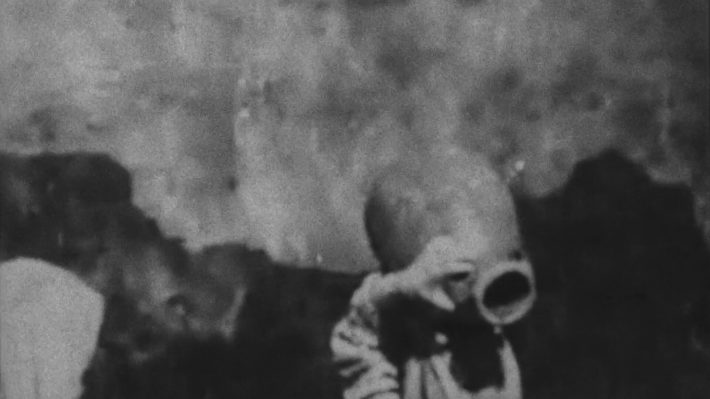
Partition (Diana Allan, 2024)
ES: I wanted to ask you about the difficulties of balancing the tension between the beauty and the pain which are so inherent in these colonial images. How did you navigate this?
DA: Beauty and pain are always fused, particularly in works like this one, which deals with stories of loss and longing. I also think that there’s a presumption of extractivism in this question: the idea that I’m taking another community’s pain and aestheticising it through documentary art practice. My hope is that the Palestinian reclamations of the images through story and song help to push against this threat of appropriation and extraction. The pain of people’s experiences, the horror of colonial violence, and the recursive colonial violence which structures Palestinian life and which emerges through these narratives, also work against the beauty in the imagery.
ES: Tell me more about the process behind placing the spoken testimony of Palestinians alongside the colonial footage. What did you want the asynchronous sound to do to these archival images?
DA: My work as an ethnographer, anthropologist, and oral historian with Palestinian refugees in Lebanon forms the background of this film. Having worked on the Nakba Archive for over two decades, I’ve spent a lot of time recording testimonies and narratives, and thinking about the forms of experience and registers of expressivity carried in different oral forms. Through sound, I was able to weave together these different voices and different moments in time in a non-linear way. One of the testimonies is that of an elderly woman talking about her life in Hawassa before 1948, about the village’s almond groves and the abundance there. This was recorded in 2003. All the other sounds in the film were gathered in the last five years. The way I listen has changed somewhat during my work in these communities. I’m now also very interested in the environmental sound of camp spaces. Ambient sound is a kind of immersive archive in and of itself. This is the first time I’ve made a surround-sound film, and my first time making one using the model of dialectical montage. The sound has become, for me, a way of deconstructing archival authority, a way of reviewing a particular kind of colonial narrative through the reverberations of a refugee present, and a way of thinking about how this ‘undoes’ the image, reconstructing it through Palestinian voices and soundscapes.
ES: Song is also a significant aspect of Partition.
DA: I think of Partition itself as a kind of song, in the sense that it has refrains. Musical form was very helpful for me to highlight the cyclicality of Palestinian displacement and to work against a sense of linearity. But when I started work on the film, I hadn’t anticipated that song was going to be so important. There are two people who sing in Partition: the first is Sumaya Al-Haj, a close friend who I recorded with very early in the process of making the film. The second, Amal Kaawash, is a well-known Palestinian singer who lives in Lebanon. She had learnt these traditional songs from different villages, and songs which are sung at ritual events. In a context where there are very high illiteracy rates, song has become very important for preserving cultural heritage. Histories are passed through families not only through stories, but also through songs and lamentations. I am interested in the idea of song as a kind of collective voice. In Partition, I wanted there to be many voices and for people not to know exactly who is speaking. Song also helps to capture that sense of polyvocality.
ES: It’s interesting that these forms of testimony which have historically been dismissed as unreliable, such as song and stories, are so central to your archiving processes of the Nakba.
DA: The Nakba is a period of history that still doesn’t have a collective, recognised narrative, in the way that the Holocaust does. While people are broadly aware of the term ‘Nakba’, so much still remains unknown about what happened in those villages from which people were expelled. In this sense, oral histories recorded with first-generation refugees – many of whom were illiterate and therefore left no written record – are crucial for helping to fill in the gaps. The audiovisual form is also important to the knowledge these histories communicate. I think that actually seeing and hearing these narratives of loss and the emotions that undergird these acts of remembrance is extremely important to their meaning and cannot be easily dismissed.
ES: I was also struck by the moments of pause within the film. What role does silence play for you within Partition’s soundscape?
DA: I incorporated silence both as a reminder that the footage was originally silent, and to give people time to process and sit with the stories. Silence gestures to all that can’t be articulated and to the gaps that exist in our understanding of the Nakba’s history. It’s also another way of withholding.
ES: You mentioned earlier that you chose to withhold the faces of those whose testimonies populate Partition, and I noticed that their names appear only in the end credits of the film. How did you strike the balance between acknowledging the very personal and individual nature of these stories, and the fact that these experiences form a collective consciousness of Palestinian life?
DA: I wanted to avoid the singular narrative that characterises a lot of documentaries about Palestinian life, in which the viewer identifies with one protagonist, whose experience is the means through which social life, political events, and history is explained. Instead, I wanted Partition to be fractured and palimpsestic, like the experience of separation and partition itself, which is fractal, prismatic, and scattered across many places, temporalities, and lives. This form is also very different from the work we are doing in the Nakba Archive, which is about understanding history and experience through particular life stories. Partition involves thinking about what a fragment of information can tell you; what one moment, or one anecdote can convey. But it also involves understanding that these intimate pieces form part of the collective condition of Palestinian life.
ES: The act of translation is also inherently one of loss and withholding. How did you navigate this, in your transposition of Arabic testimonies into English text throughout Partition?
DA: Translation is very challenging – it is an act that will always perpetuate loss. I worked closely with Hoda Adra on the translation of Partition. She did the translations for Voices of Nakba (2021) and she is a spoken word poet so she has a great capacity for capturing the idioms and rhythms of speech. There are sections of the film which I intentionally left untranslated, with the idea that the viewing experience will be different for Arab audiences, that there are things which will not be accessible to non-Arab speakers. Even in moments where there are subtitles, there are parts that I didn’t translate. I thought quite carefully about those moments.
ES: I find the balance that you tread between making the film accessible and experimental fascinating…
DA: It’s a difficult balancing act. There’s an unspoken rule that films about Palestine should be politically enabling, and that anything overly aesthetic is somehow unethical, or indulgent, or narcissistic. People often ask me who the audience is for this film. Behind that question is another: what is the purpose of this film? There is an idea that it should somehow be doing something. Partition has been to more festivals than any other in my filmography, which is somewhat surprising given its form demands quite a lot from the viewer. This is probably partly due to timing, but I think it is also because it approaches the Palestinian catastrophe in a somewhat indirect and perhaps unexpected way. There are many films that try to ‘explain’ the conflict and adopt a particular visual grammar for doing so. This film is an attempt to explore other less expository strategies for representing Palestinian experience. Its somewhat oblique form has probably made it easier for programmers in this moment where there is so much censorship and silencing and anxiety surrounding programming anything to do with Palestine. It’s a bit of a Trojan horse, because it’s not only about the history of British colonialism, but also about the tragedy unfolding in Gaza today, and these ongoing histories of violent displacement and ethnic cleansing.
This interview was conducted during Open City Documentary Festival 2025 in the framework of the Critics Workshop with Another Gaze.