Morgan Quaintance on Available Light

By Clodagh Chapman
First becoming known for his work as an art writer, curator and broadcaster, Morgan Quaintance has since developed an impressive body of moving image artworks, exhibited in festivals and gallery spaces globally. Alongside all this, Quaintance also works as a musician, including composing for his own films. This brings us back full circle: before his entry into the art world, he was a touring musician.
Quaintance’s moving image work plays with archive footage, abstract imagery and onscreen text, and often pulls together unlikely, but affectively resonant, ideas. In A Human Certainty, Quaintance explores death, grief, and the end of his own long-term relationship, while Efforts of Nature sees Quaintance exploring change on both personal and global levels. Quaintance has also made a series of more formally playful micro-shorts, dubbed ‘Miniatures’, many shot on obsolete digital cameras.
Available Light [2024] is Morgan Quaintance’s latest longer-form work. Made between Tokyo and London, and comprised of interviews with workers at the Edo-Tokyo Open Air Architectural Museum and renters in London and Tokyo, Available Light explores ideas of home, rest, and residential precarity. Notably, Available Light was the product of an unconventional collaboration with Dr Laura Harris, a sociologist at the University of Southampton. Harris and Quaintance visited Tokyo together, working on the site in parallel rather than direct partnership, but both were interested in questions of place and atmosphere.
Available Light bears the hallmarks of a Morgan Quaintance film. The film begins on an opening sequence of brightly coloured celluloid light leaks. City scenes dissolve in and out of legibility, with celluloid film allowing for a warping of nighttime sequences into something slower and more dreamlike, and onscreen text shifts from subtitles into commentary. Dreams, too, are a recurrent motif in the film: a museum security guard narrates his dreams, and there is a repeated sequence of commuters walking through a Tokyo subway, as though the film is stuck in a strange sort of looping dream.
Available Light ends with a self-reflexive pivot: in an overdub which sounds like a series of late-night voice notes, Quaintance speaks with collaborator Chiemi Shimada. Together, Shimada and Quaintance reflect on sleep, dreams, and the film itself: why is Quaintance, in the absence of any obvious personal ties to Japan, making a film about Tokyo?
We spoke on the morning of the film’s screening at Open City Documentary Festival.
Clodagh Chapman: I’m interested in how you got started as a filmmaker – particularly that shift from working as a writer and curator into making moving image work.
Morgan Quaintance: I really wanted to make films. I was always watching a lot of films. I used to work in the bookshop at the National Film Theatre [now the BFI], and I was always interested in avant-garde stuff. Around the time I graduated, Dogme 95 emerged, and I was like, ‘Maybe I could do that using a DV camera.’ But the reality of making films was so far away; I didn’t know how you could do it.
That only changed when I worked for the BBC as a broadcaster. On location, it was just one cameraman, the director, and me. I was like, ‘I can totally do that.’ Even then, I wasn’t thinking, ‘I’m going to be a filmmaker.’ I was just like, ‘I want to make films’ – maybe as part of my curating practice. You know, the film you watch when you go into the exhibition, that tells you about it? I thought that was another thing I could do as a curator. I was in a curatorial collective with two other people, and I suggested it to them, and they were a bit uncomfortable. So I thought I would just do it myself instead. I made this film for Cubitt Gallery, called Cubitt 25 Years [2016]. And then at some point, I made my first film, Another Decade [2018]. But, if things had gone another way, I maybe never would have done it.
CC: The first couple of films are stylish, but there is a proximity to observational documentary.
MQ: Yeah. That was a choice. At first, I was like, I’m going to make two films: one is going to be a bit more expressionistic, and the other is going to be straightforward documentary. Letter from Tokyo [2018] is straightforward documentary. Another Decade still has documentary elements, but not exclusively. When I did Letter from Sapporo [2021], that’s when I was like, ‘Okay, keeping this separation isn’t really working.’ A Human Certainty [2021] is a step further into abstraction.
CC: It’s interesting, that progression. Written onscreen text, for example, is there as early as Another Decade, but it develops – it takes on an ironic tone in A Human Certainty, for example.
MQ: I’m glad that there is some sense of a progression! Often people get stuck, or they reproduce the same thing. In many ways, my films progress according to a kind of baton-pass logic, but I’m always trying out different things. In Repetitions [2022], I was interested in types of editing. In this new film I’m working on, I want to try to use quite a lot of text, maybe creating a bit more of a literary vibe.
One of the things that can happen when you start making a lot of work, and people start to like it, is that you can get a bit insular. I remember when I used to play in bands, I’d be on tour and I’d come home and try to make my own music, and I would make stuff that sounded just like the band, because I was around them all the time. I’m really enthusiastic about other people’s work, because it pushes me to go elsewhere. I try to see as much as I can, because you always come across something that makes you think, ‘Oh my God, I never knew you could do that.’
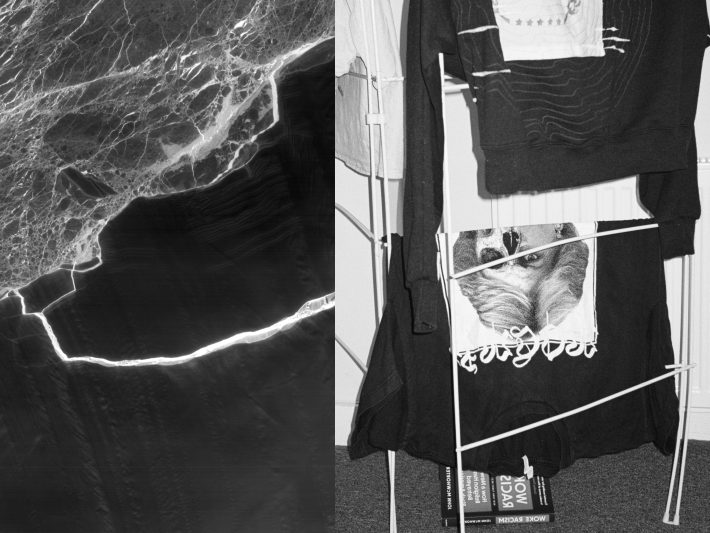
Efforts of Nature (Morgan Quaintance, 2023)
CC: There is a real shift between A Human Certainty and Efforts of Nature [2023], in particular. During this time, you made lots of really short works in quick succession.
MQ: Yeah. After I made Surviving You, Always [2020] and A Human Certainty, I was getting caught in this autobiography thing. I really wanted to do something else, but I got quite a lot of attention for those films, so I had to make a bit of a break. Those short films gave me an opportunity to try things with zero pressure. I could try types of animation or different approaches to duration.
CC: Lots of those shorts have a playful way of manipulating analogue forms, too.
MQ: What happened was my camera broke! It did this rolling shutter if I put it on 64fps. I thought, ‘Oh, no, I actually really like this…’ So I started using it more and more, experimenting with it and redefining what I wanted it to do. Now I’m never going to get my camera fixed.
CC: That brings us nicely onto Available Light: there’s manipulation of celluloid film in that, and lots of arrestingly weird images. What did the process of making that film look like?
MQ: It was a little bit of a panic process, because I knew what I had to produce. There was somebody else involved with me, the sociologist Dr Laura Harris. We took the decision early on just to work in parallel. We had a shared conceptual territory, which was the environment at the Open Air Museum, and then we were doing our work together, but separately.
CC: Do you feel that it changed the direction of the film at all?
MQ: I don’t think so. It helped because I didn’t have to do any of the exposition: Laura was doing all of that. On her side of the project, she talks about the practical nature of the place. It helped me to be like, ‘I’m not focusing on any of that.’ My film is more to do with affect. I wasn’t as interested in the location. The film is more a conversation between the preservation of ideal museum spaces and the precarity people live through. I’m not really that interested in architecture as a design practice; I’m more interested in it as a lived reality. What takes place within the walls? What can take place within the walls? Who has access to this place? What I liked about the museum is that it allowed me to have an embodied glimpse of another life, but not one that I’m ever going to live.
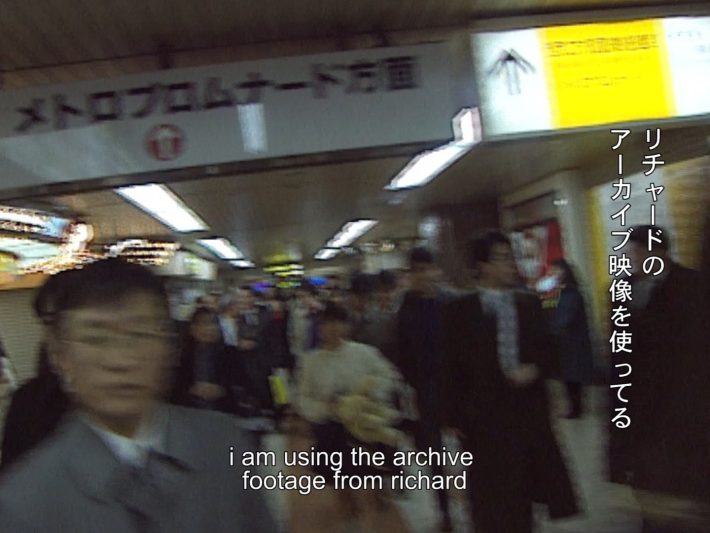
Available Light (Morgan Quaintance, 2025)
CC: It feels like there’s a similar strategy in Letters from Tokyo, in which you peel back the glossy layers of Tokyo’s image.
MQ: You can’t really help it in that city. But I’ve tried to do that without generalising. From a foreigner’s perspective, I guess any city is like that.
CC: Towards the end of Available Light, the film anticipates its own reception. Was that always something you intended on including?
MQ: That part was originally much longer and much more explicit. I had this sense of people being like, ‘Is this some fetish of yours? Why are you so interested in Japan?’ Or, ‘You have to be careful, maybe this is cultural appropriation.’ Why can’t experiencing Japan be universal in the way that experiencing New York is? If I made a film about the Bowery in 1980, nobody was going to say I was fetishising New York.
And then I was speaking in Japanese… I’m really uncomfortable with my voice, basically, but it felt right for me to speak Japanese with Chiemi. It didn’t feel like a performance, so to speak. It felt like I was rooting it in that location.
CC: What was collaborating with Chiemi Shimada like? She is a credited as a translator, but also appears in the film. Her own film is playing alongside yours tonight in the Open City programme.
MQ: Actually, we met last year at Open City! María introduced us because we were both going to Japan at the same time. So we hung out a little bit in Tokyo, and then I needed some help with the translation. Chiemi was up for it. Then I was talking to her about her own experience of renting. It was serendipitous, not necessarily planned, but the collaboration made total sense.
CC: Is serendipity important to your work?
MQ: It is. I think the reason it works that way is because I have a very strong conceptual framework for each project. I’m approaching archival footage, books, conversations, everything with an organising idea, so it will all come together. There is no shot list when I’m filming. I can’t do it any other way. I wish I could, because that might be easier, but this just feels more natural. I think it’s more interesting for the audience, because they feel it’s a process of discovery too. I like that in films: when you don’t know what’s going to happen next. I’m always trying to come up with sequences that I think are going to be a bit surprising, or at least take you somewhere different.
CC: When does sound come in?
MQ: Sound is always the starting point. There’s always a sound world I’m thinking of, that I want to build the film out of, before I’ve made it. I’ll get a playlist together. With Efforts of Nature, I was listening to sample-based music: a lot of hip hop, but quite underground stuff. With Repetitions, I guess that was a bit more avant-garde classical. With the new film I’m working on, I’ve been listening to a lot of industrial noise music.
With Available Light, I knew I wanted it to have this flowing feel. I wanted it to be jazz-orientated, with a dreamlike quality. I guess that mirrors the experience of being in Japan or somewhere foreign, doing a project. You’re not really in society because you’re there for a month, but you don’t have to work, you don’t have to worry about anything. On the residency, there was a grand piano, so I was just writing a lot of music. All the piano bits in it are what I was composing on the residency, and then I went into a studio and recorded some of that. We’ve actually done this whole touring thing with Available Light, where we’re doing live performances as a group: me, a cello player, a drummer, a sampler. We travel with the show; the first performance was at Cafe Oto. It was just music and sound, really.
CC: With no film?
MQ: No film. It was very gig-focused. There was some moving image, but not from any of the films. It was new stuff. Then, at Courtisane [a film festival that takes place in Ghent], it happened across this theatre space: something was happening at the front, then you had to turn this way to see some stuff, then there was something over there with someone else. I really want to do that with my films. I just want to push that use of space further and further.
CC: Like expanded cinema?
MQ: Expanded, yeah. I want to have the film as a central point, but for live performance, spoken word, screening programmes, exhibitions to emerge from that. Later in the year, in London, we’re doing a physical installation, but none of the video is going to be in there. Just images, photography, text. I’m really trying to do something different where it’s like, I make a film every year and that film sits at the centre of an expanded project.
This interview was conducted during Open City Documentary Festival 2025 in the framework of the Critics Workshop with Another Gaze.